
September 29, 2026 · Condo & Townhome Buyer Guide
Cleveland Condos vs. Townhomes: HOA Dues From $50 to $1,540 a Month and How to Vet Reserve Funds
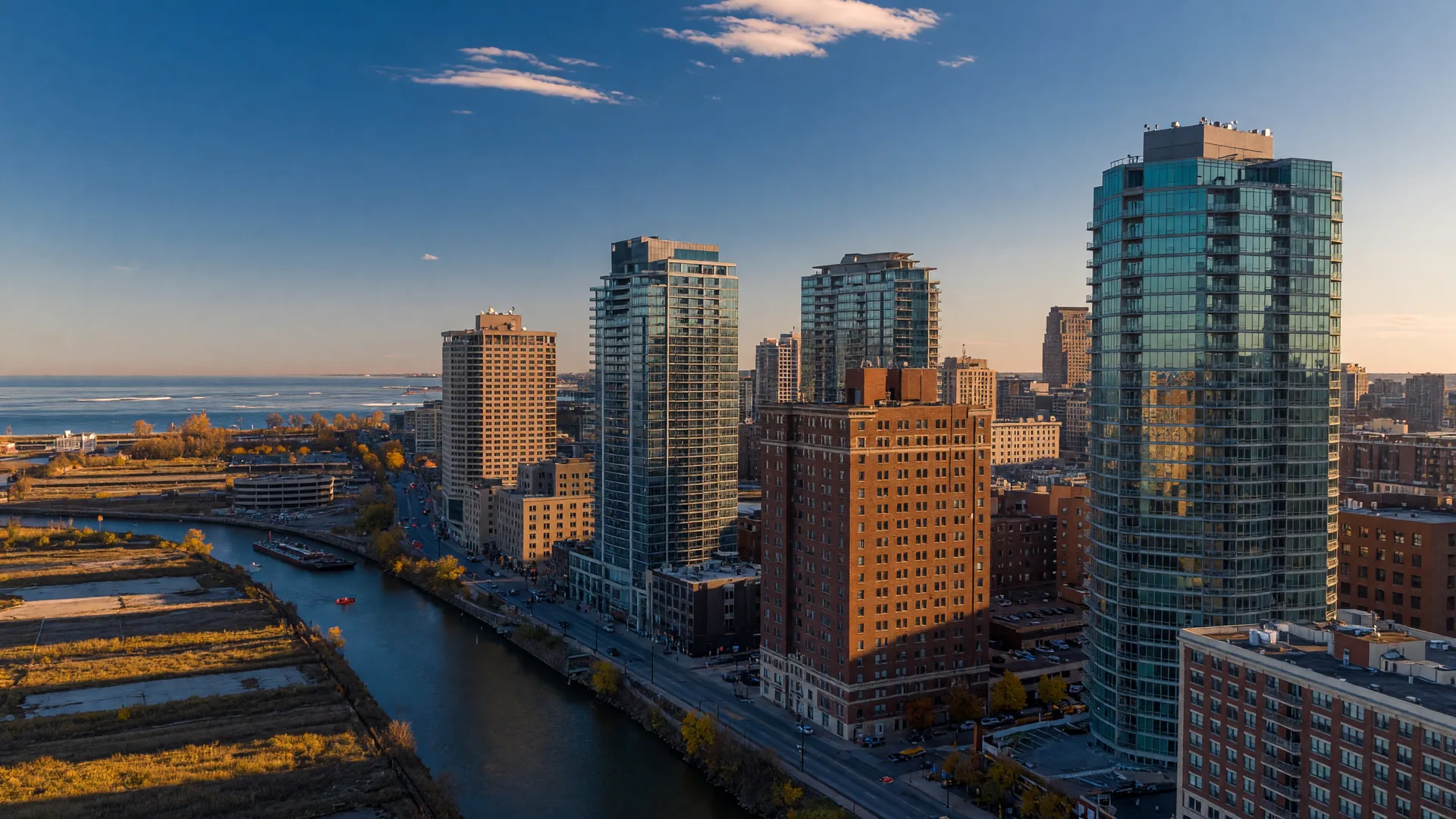
Downtown Cleveland condo assessments range from about $220 a month at the Stonebridge Condominiums to roughly $1,540 a month at The Pinnacle, while fee-simple townhomes in Ohio City neighborhoods commonly carry HOA fees of $50 to $250 a month. The gap reflects what each fee actually owns: condo dues buy a master insurance policy, elevators, lobbies, shared amenities, and building reserves, while a townhome fee typically covers roofs, siding, and common grounds shared with a handful of neighbors. Because Ohio Revised Code Chapter 5311 no longer sets a fixed reserve floor, reserve fund health varies building by building, and the budget, the reserve study, and the board minutes are the documents to read before you write an offer.
Cleveland's downtown housing stock is also genuinely mixed, which surprises out-of-market buyers. A Newmark research report from October 2025 counted 35 office buildings in downtown Cleveland converted to residential or mixed use since 2013, roughly 7.4 million square feet of it, and CBRE has described Cleveland as leading the United States in the share of office inventory under conversion. Some of the most recognizable downtown addresses are actually rental towers, not condos. The 9 (the Residences at 668 Euclid Avenue), Reserve Square at 1701 East 12th Street, and Crittenden Court at 955 West Saint Clair Avenue are all rental apartment buildings with no HOA fees at all. So the realistic downtown Cleveland comparison is condo association versus fee-simple townhome, plus a clear-eyed read on which buildings you can buy into at all.
Why Do Downtown Cleveland Condo HOA Fees Range From $220 to $1,540 a Month?
The spread comes down to four variables: unit size, the number of units sharing the building, the age and mechanicals of the building, and the amenity package. A 157-unit mid-rise like Stonebridge on the West Bank of the Flats spreads its master policy and maintenance across many owners; a boutique luxury tower like The Pinnacle at 701 West Lakeside Avenue, with residences running from roughly 1,500 to 6,000 square feet, spreads the same categories of cost across very few large units, so the fee lands near $1,540. When you compare buildings, price per square foot is the honest metric, and full-service downtown condo dues in current listing data typically land in the $0.35 to $0.75 per square foot range, with luxury towers above $1.00.
Here is the fee picture across a handful of downtown Cleveland buildings and nearby townhome rows, with the reporting date for each figure. Fees change with every association budget year, so treat the table as a snapshot, not a quote.
| Building / community | Location | Type | Reported monthly fee | Source and date |
|---|---|---|---|---|
| Stonebridge Condominiums | West Bank of the Flats | High-rise condo, 157 units, built 2005 | $220 (1BR) · $254 (2BR/1BA) · $272 (2BR/2BA); listing data on larger units runs higher | Official association FAQ, Jan. 2024; Homes.com listing data, 2026 |
| The Pinnacle | 701 W. Lakeside Ave., Warehouse District | Luxury high-rise condo, units ~1,500 to 6,000 sq ft | ~$1,540 average | Highrises.com and MyClevelandCondo, 2026 |
| 1133 W. 9th St., unit 604 | Warehouse District | Condo listing example | ~$498 | Downtown Cleveland listing data, 2026 |
| Bailey Bridge Townhomes | Ohio City | Fee-simple townhomes | ~$50 | Ohio City townhome listing data, 2026 |
| The 9 / Residences at 668 | 668 Euclid Ave. | Rental residences (no HOA) | Rents ~$1,202 to $2,425 | Apartments.com, 2026 |
| Reserve Square / Crittenden Court | Downtown (1701 E. 12th St. / 955 W. St. Clair Ave.) | Rental apartments (no HOA) | Rents ~$865 to $2,296 / ~$935 to $1,295 | Apartments.com, 2026 |
Reporting note: association and listing figures accessed September 2026. Rental figures are included to show which downtown addresses are not purchase options at all.
Condo Fees vs. Townhome HOA Fees: What Each Dollar Actually Covers
The structural difference drives the fee difference. A condo owner owns the air space inside the unit plus an undivided share of the common elements: the building shell, roof, corridors, elevators, and land under the building. The condominium association carries master insurance on the structure and pays for everything shared, so the monthly assessment is effectively the building's operating budget split among owners. A fee-simple townhome owner owns the unit and the land under it, like a single-family home attached to neighbors, and the HOA is a much smaller entity that typically covers roofs, siding, landscaping, snow removal, trash, and shared drives or plazas. The owner stays on the hook for the interior, appliances, and utilities.
In Ohio, the fee aggregator HOACosts puts Cleveland's average reported HOA fee near $622 a month across 33 community reports, versus a state average near $289 a month, a gap driven by full-service high-rise condominium associations. Community management sources describe typical Cleveland condo and townhouse fees in the $200 to $400 a month band for mid-market communities. Downtown clinics the averages in both directions: a small one-bedroom in a converted mid-rise can sit under $250, and a penthouse-scale residence in a luxury tower clears $1,000. A handful of newer townhome rows in the near-west neighborhoods carry no HOA at all, which just means any shared roof, retaining wall, or drive repair gets paid out of pocket when it happens.
| Cost category | Condo association (downtown high-rise) | Townhome HOA (fee-simple) |
|---|---|---|
| Ownership | Air space in unit + undivided share of common elements | Unit and land under it, like an attached single-family home |
| Master insurance | Usually included in the fee, structure and common areas | Individual owner policies; HOA may carry master coverage |
| Root, facade, structure | Association responsibility via the fee | Often HOA-covered in attached rows; confirm in the declaration |
| Elevators, lobby, common corridors | Association responsibility via the fee | Rarely applicable; possibly shared stairs or walkways |
| Water, sewer, trash | Often bundled into the fee | Usually billed to the owner; trash may be shared |
| Reserve funding | Line item in the association budget; adequacy varies by board | Smaller line item; roofs and drives are the big-ticket items |
| Typical range, current data | ~$220 to $1,540/mo by building; ~$0.35 to $1+ per sq ft | ~$50 to $250/mo in near-west neighborhoods; some rows none |
What Does Ohio Law Actually Require for Condo Reserve Funds?
This is the part of the comparison that matters most, because the law changed recently. Under Ohio Revised Code Section 5311.081, a condominium board must adopt an annual budget that includes reserves "in an amount adequate to repair and replace major capital items in the normal course of operations without the necessity of special assessments." That adequacy standard replaced a fixed floor: from 2004 until September 2022, Ohio law required at least 10 percent of the annual budget to be set aside for reserves. Senate Bill 61, effective September 2022, removed the 10 percent floor, so today the board largely self-assesses what adequate means.
Two important gaps follow. Ohio does not require associations to commission professional reserve studies, though a dated third-party reserve study is the industry-standard evidence that reserves are actually adequate. And the reserve requirement can be waived entirely in two ways: if the declaration or bylaws limit the board's authority to raise assessments without an owner vote, or if unit owners holding a majority of voting power waive the reserve requirement in writing each year. When reserves are thin, major repairs get funded through special assessments, which Ohio law allocates proportionately across all units under Ohio Revised Code Section 5311.01. That is the mechanism that turned into surprise bills in the "condominium roulette" era that prompted the original 2004 reserve mandate.
| Rule | Status today | What a buyer should do |
|---|---|---|
| Annual budget with adequate reserves | Required in ORC 5311.081; "adequate" is board-determined | Ask for the line item in the adopted budget and compare it to the reserve study |
| Fixed 10% reserve floor | Removed by Senate Bill 61, effective Sept. 2022 (was law 2004 to 2022) | Do not assume a percentage floor exists; verify the actual funding level |
| Professional reserve study | Not mandated by state law; recommended practice | Ask for the most recent study and its date; a stale study is a red flag |
| Waiver of reserve funding | Allowed if a majority of unit owners waive in writing each year, or the declaration limits assessment authority | Review the minutes and the declaration to see whether a waiver is in place |
| Special assessments | Allocated proportionately across units under ORC 5311.01 | Ask the board about pending or recent special assessments and upcoming capital work |
How Do I Check a Building's Reserve Fund Health Before I Make an Offer?
In our experience helping buyers work through downtown Cleveland condo packages, the documents do the talking. A purchase is approved subject to review of the association package, and the buyer or the buyer's attorney should review, at minimum: the current operating budget showing the reserve line item, the most recent professional reserve study and its date, 12 months of board meeting minutes, the declaration and bylaws, a certificate of insurance for the master policy, and any special assessment notices. If the reserve study is more than three years old, if the budget's reserve line matches none of the study's recommendations, or if the minutes show deferred elevator or roof work with no funding plan, the building is living on borrowed time, and the borrowed time becomes a special assessment on your unit.
Converted buildings deserve extra attention because their capital cycles are predictable and expensive. When a 1920s or 1890s office tower becomes condos, the elevators, boilers, windows, and facade all carry decades of deferred maintenance, and the conversion economics often fund the rehab but not the next 30 years. Cleveland's conversion wave is real: Newmark's October 2025 report documented 35 converted buildings since 2013, and CBRE has ranked Cleveland first in the United States for the share of office inventory in conversion. Newer examples include the Rockefeller Building at West 6th and West Superior, acquired in March 2026 by K&D for residential conversion, and the 1898 building at 700 Prospect, becoming the Residences at 700 Prospect. Each of those conversions becomes a freshly patrolled condo association or rental product, and the age and mechanical condition of the original building set the reserve budget from day one.

Is the Downtown Cleveland Condo Market Active Right Now?
Yes, and the data carries a volume caveat. Redfin's Downtown Cleveland neighborhood snapshot, which mixes condos, townhomes, and the small number of single-family homes downtown, recorded a median sale price near $380,000 and a median price per square foot near $176 as of mid-2026, with sharp swings between periods because the sales pool is small. What those swings do not tell you is the fee story, which is why the number to run on any specific unit is delivered price plus monthly assessment plus annual property tax, not list price alone.
Run that math before you compare buildings. A $280,000 condo with a $500 monthly assessment can cost more per month than a $340,000 townhome with a $100 HOA, once the assessment, taxes, and insurance are in. Ballpark the assessment in per-square-foot terms first, then confirm the actual number in the association package, and remember that assessments are set by the association budget, not by the seller, so they are not negotiable at the closing table.
Do Cleveland Condos and Townhomes Qualify for Property Tax Abatements?
New construction and conversions can, under the city's Community Reinvestment Area (CRA) program. Cleveland restructured residential abatement with Ordinance 482-2022, effective January 1, 2024. The program now grants 15 years of abatement on the increased assessed value, with the land itself staying on the tax roll, at percentages set by CRA subarea: 85 percent for strong and market-rate subareas, 90 percent for middle-market areas, and 100 percent for opportunity subareas, for single-family and two-family new construction, with home value caps near $350,000, $400,000, and $450,000 by subarea. Rehabilitation and conversions of single- and two-family homes are generally abated at 100 percent with a $450,000 cap. Multi-family projects of three or more units, which is how condo-platted buildings count, qualify at 85 to 100 percent depending on subarea and must satisfy affordable set-aside requirements. Green Building Standard compliance and an occupancy permit are required in every case.
The practical point for the condo versus townhome decision: Cleveland classifies projects by unit count, not by legal form. A fee-simple townhome row of one or two units rides the single-family schedule with the value caps; a three-plus-unit condo project rides the multi-family schedule with the set-aside requirement. So a new-construction townhome and a new-construction condo in the same subarea can carry materially different tax situations. Confirm the subarea, the cap, and the set-aside status for the specific project with the Cuyahoga County Fiscal Officer and the city's community development department before you rely on the number in any pro forma.
| Project type | Abatement | Notes |
|---|---|---|
| Single/two-family new construction | 15 years on increased value; 85% / 90% / 100% by CRA subarea | Value caps near $350k / $400k / $450k by subarea; land remains taxable |
| Rehabilitation and conversions, single/two-family | Generally 100% for 15 years on increased value | $450,000 cap; conversion of nonresidential space requires qualifying costs over $2,500 |
| Multi-family, 3+ units (incl. condo projects) | 85% to 100% for 15 years by subarea | Affordable set-aside requirements or Community Benefits Agreement; condo classifications count units, not legal form |
| All abated projects | None without compliance | Green Building Standard compliance and an occupancy permit required |
Source: City of Cleveland, 2024 Tax Abatement Program Chart and program guidance, accessed September 2026.
Buyer and Seller Takeaways
- Buyers: before offering on a downtown Cleveland condo, request the operating budget with the reserve line item, the most recent reserve study and its date, 12 months of board minutes, the declaration, and the master policy certificate. Have an attorney review the package during your contingency period.
- Buyers: compare buildings on total monthly cost, not price alone: mortgage payment plus assessment plus taxes plus insurance. A low-price unit with a fat assessment is not the deal it looks like.
- Buyers: for new construction or conversions, confirm the CRA subarea, the abatement percentage and cap, and any affordable set-aside requirement with the Cuyahoga County Fiscal Officer before relying on a tax estimate.
- Buyers: in converted buildings, ask specifically about elevator, boiler, roof, window, and facade condition, the age of the reserve study, and any pending special assessments.
- Sellers: keep the association package current and paperwork clean, because a buyer's lender will also review the association's insurance and finances, and a waived reserve fund can stall a loan.
- Everyone: this is general education about structures and Ohio condo law, not legal, tax, financial, or mortgage advice. Consult a qualified attorney, your title company, your lender, and an Ohio-licensed condo document reviewer for your specific transaction.
If you are comparing downtown Cleveland against the rest of the region, our Northeast Ohio region guide maps the eight-county market, and our guide to moving to Northeast Ohio compares Cleveland and Akron housing, costs, and commutes side by side. Buyers weighing an attached home in any Ohio market can also use our single-family versus townhome versus condo breakdown, which walks through ownership, fees, and resale for each product type. Downtown Cleveland is where that trade-off is sharpest: a full-service tower with funded reserves, or a fee-simple townhome with a light HOA and a direct line to your own roof.
Frequently Asked Questions
How much are HOA fees for condos in downtown Cleveland?
Current data shows monthly assessments from about $220 at the Stonebridge Condominiums to about $1,540 at The Pinnacle, with mid-market condo and townhouse fees commonly in the $200 to $400 range. In per-square-foot terms, full-service downtown condo dues typically run $0.35 to $0.75 per square foot, with luxury towers above $1.00.
What is the difference between a condo and a townhome in Cleveland?
A condo owner owns air space plus a share of common elements, and the association covers the building shell, roof, corridors, and often elevators and amenities through the monthly assessment. A fee-simple townhome owner owns the unit and the land under it, like an attached single-family home, and the HOA typically covers roofs, siding, landscaping, snow removal, and shared drives.
Does Ohio require condos to have reserve funds?
Ohio Revised Code Section 5311.081 requires boards to budget reserves adequate to repair and replace major capital items without special assessments, but the fixed 10 percent floor that existed from 2004 was removed by Senate Bill 61 in September 2022. Today the board determines adequacy, professional reserve studies are not statutorily mandated, and a majority of owners can waive reserve funding in writing each year.
What happens if a condo association has no money in reserves?
Major repairs get funded through special assessments, which Ohio law allocates proportionately across all units under ORC 5311.01. That is how a leaky roof or a failing elevator becomes a five-figure bill per unit. Review the budget, the reserve study, and the board minutes so you know whether the reserves are funded before you buy.
Do I pay property taxes on a Cleveland condo or townhome?
Yes. Qualifying new construction and conversions can receive a 15-year CRA abatement on the increased assessed value, with the land remaining taxable, at 85, 90, or 100 percent depending on subarea. Fee-simple townhomes of one or two units use the single/two-family schedule; condo projects with three or more units use the multi-family schedule with affordable set-aside requirements.
Can I negotiate HOA dues when buying a Cleveland condo?
No. Assessments are set by the association's budget and are the same for every owner of the same unit type; they are not a term the seller can change. You can and should factor the assessment into your offer price, and your lender will review the association's finances, so a building with weak reserves can affect both the loan and your negotiating position.
Sources
- Ohio Revised Code Section 5311.081 (board duties, annual budget, and the adequate-reserves standard)
- Ohio Revised Code Chapter 5311, Condominium Property (special assessments and common assessments)
- Otte, Senate Bill 61: Ohio Condominium Act Amendments (removal of the 10% reserve floor, effective September 2022)
- Stonebridge Condominium Association FAQ (official monthly dues by unit type, January 2024)
- Homes.com, Stonebridge Plaza Condominiums (listing-reported fee range across units)
- Highrises.com, The Pinnacle at 701 W. Lakeside Ave. (average HOA dues and unit sizes)
- MyClevelandCondo, The Pinnacle Building (downtown Cleveland condo listings and fees)
- Redfin, Downtown Cleveland Housing Market (median sale price and price per square foot, accessed 2026)
- NEOtrans, Downtown Cleveland's Next Transformations (Newmark report: 35 conversions since 2013, ~7.4 million sq ft)
- City of Cleveland, Residential Tax Abatement (CRA program rules and subareas)
- City of Cleveland, 2024 Tax Abatement Program Chart (percentages and value caps by subarea and project type)
- Cleveland City Council, Restructuring Residential Tax Abatement (Ordinance 482-2022 context)
- Cuyahoga County Fiscal Officer, Abatements (administration of the tax abatement program)
- Steadily, HOA Laws and Regulations in Cleveland (typical fee ranges for condos and townhouses)
- HOACosts, Ohio HOA Fee Averages (Cleveland vs. Ohio reported averages)
- Redfin, Ohio City Townhomes for Sale (Bailey Bridge Townhomes listing-level HOA data)
- Apartments.com, The Residences at 668 (rental product, no HOA)
- Fee, market, and program details reviewed September 29, 2026.
Share This Post
Suggested social caption
"Downtown Cleveland condo HOA dues run from about $220 a month to $1,540 a month, and Ohio no longer requires a 10 percent reserve floor. Here is how to compare a condo tower's fee package and reserve fund health against a fee-simple townhome, with real building data from Glasshouse Realty."
Published September 29, 2026 · Updated September 29, 2026 · Information verified on September 29, 2026 against the sources listed above. HOA fees, reserves, and abatement rules can change with each association budget year and ordinance cycle; confirm current figures with the association, the Cuyahoga County Fiscal Officer, and the City of Cleveland before you act.
Buying a downtown Cleveland condo or townhome?
Get a no-pressure, data-backed read on the Cleveland market: which downtown buildings are worth a deeper look, what the association documents should say, and whether a condo tower or a fee-simple townhome fits your monthly numbers. We know every corner of the Greater Cleveland market.
Talk to an AgentExploring the Cleveland market?
Whether you are comparing downtown condos, near-west townhomes, or suburbs along the lake, a Glasshouse agent can pull the association packages, run the monthly numbers, and show you what fits your budget before you look at a single listing.
No pressure, no guesswork. Just honest, local answers from a team growing across Greater Cleveland and Northeast Ohio.
Schedule a Consultation