
September 29, 2026 · Well & Septic Buyer Guide
79% of Geauga County Homes Run on Private Wells: What to Test Before You Buy
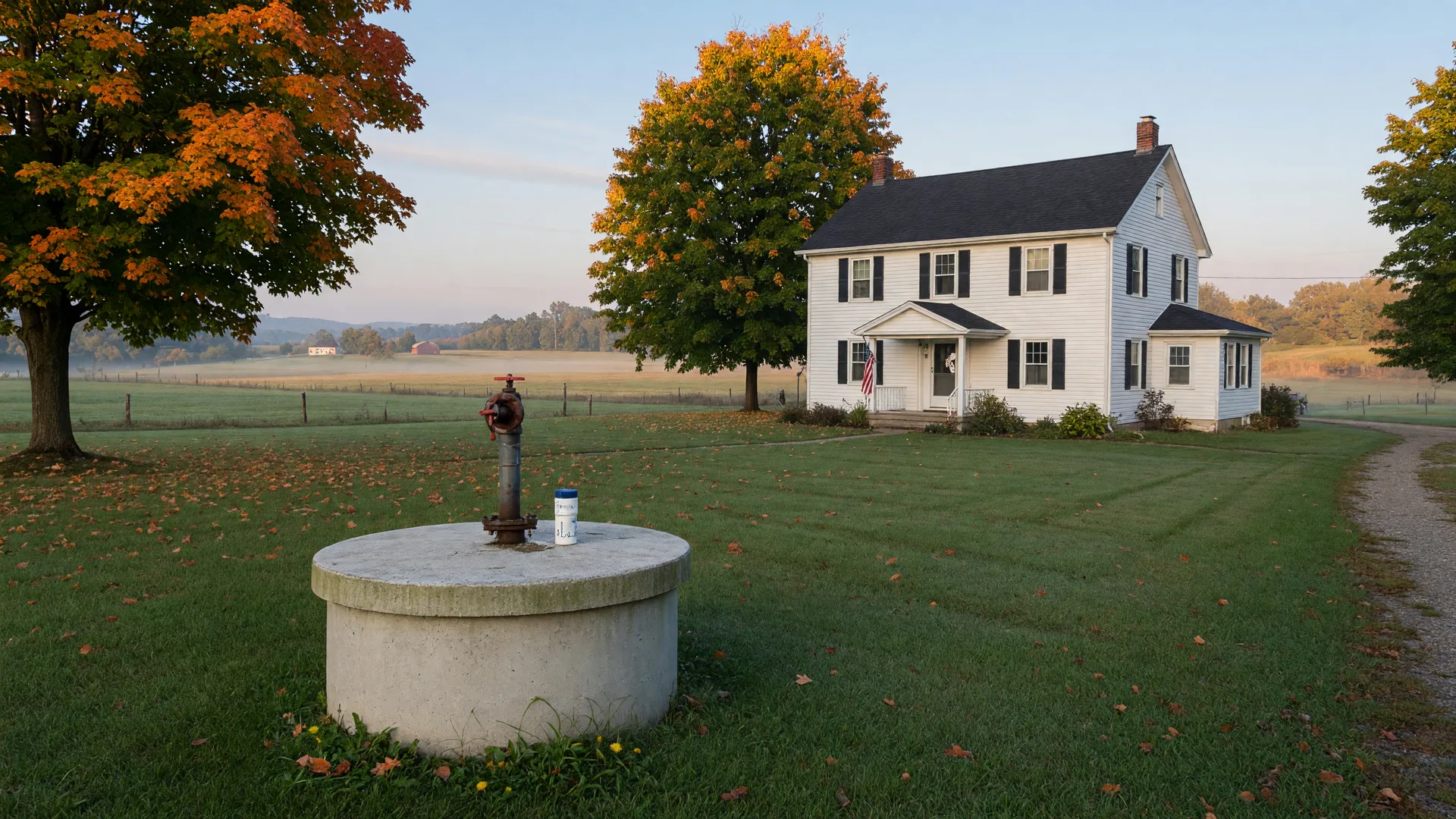
Before you buy a home on a private well and septic system in Geauga County, test the well water for total coliform and E. coli bacteria, nitrate, arsenic, iron, manganese, hardness, pH, and total dissolved solids, and have the septic system evaluated separately. Roughly 79 percent of Geauga County residents get their drinking water from domestic wells, and the county is home to about 30,000 private septic systems, so this is the norm here, not the exception. The testing is straightforward, the county lab makes it easy, and knowing the results before you write an offer protects both your health and your budget.
Geauga County is Cleveland's far east suburbs, and it wears that identity proudly. The county seat of Chardon sits roughly 36 to 41 miles east of downtown Cleveland, about 40 to 45 minutes by car via State Route 44 north to I-90 at Mentor. The county's 16 townships, led in population by Bainbridge Township and Chester Township, are deliberately rural and low-density, which is exactly why private wells and septic systems are the standard. Public water and sewer service is concentrated in the county's municipalities and a limited number of subdivisions, operated by the Geauga County Department of Water Resources; township homes are primarily served by private systems.
How Common Are Private Wells and Septic Systems in Geauga County?
More common than public water and sewer, full stop. The U.S. Geological Survey (USGS) reports that domestic wells supply about 79 percent of Geauga County residents, and Geauga Public Health estimates the county has roughly 30,000 private home sewage treatment systems, with about 70 percent of homeowners on private septic. If you are shopping in Chardon, Chester, Russell, Bainbridge, Munson, Newbury, Burton, or any of the county's other townships, assume the property you are looking at runs on a well and a septic system unless the listing or the seller's disclosure says otherwise.
That changes how you evaluate a home. A city water bill and a sewer tap are replaced by a well that needs testing and a septic system that needs inspection, and both carry real costs if they fail. Here is the county at a glance.
| Measure | Figure | Source |
|---|---|---|
| Residents served by private domestic wells | ~79% of county residents | USGS, Groundwater Quality in Geauga County (SIR 2015-5032) |
| Private septic systems in the county | ~30,000 | Geauga Public Health |
| Homeowners on private septic | ~70% | Geauga Public Health, 2015 |
| County population | 95,397 (2020 census) | U.S. Census Bureau |
| Chardon to downtown Cleveland | ~36-41 miles, 40-45 minutes | SR 44 to I-90 at Mentor |
What Should I Test For in Geauga County Well Water?
A standard homeowner well water panel covers the parameters that matter most for health and for the home itself. The Ohio Department of Health, which regulates private water systems in Ohio under Ohio Administrative Code Chapter 3701-28, recommends regular testing for total coliform, E. coli, nitrates, and arsenic, and OSU Extension recommends testing at least once a year. For a purchase, run the full standard panel so there are no surprises at the closing table.
Geauga County's own monitoring gives you the context for why each test matters. The USGS has tracked groundwater quality in the county's four main aquifers since 1978, and its most recent report (Scientific Investigations Report 2015-5032) found that iron and manganese were the constituents that most often exceeded federal secondary (aesthetic) standards, that nitrate has never been detected above the federal limit of 10 mg/L, and that strongly reducing groundwater in some wells is associated with naturally occurring arsenic and manganese above health-based benchmarks. This is precisely why a test of the specific well on the property you are buying matters more than any county-wide generalization.
| Parameter | What it indicates | Geauga County context |
|---|---|---|
| Total coliform / E. coli | Bacterial contamination, surface or septic influence | The most requested test at the county lab; a positive result triggers well chlorination |
| Nitrate | Fertilizer or septic-system influence | No sampled well above the 10 mg/L federal limit in USGS monitoring |
| Arsenic | Naturally occurring, linked to reducing groundwater | Detected above health benchmarks in some wells in reducing aquifers |
| Iron | Staining, metallic taste, pipe buildup | Most frequent secondary-standard exceedance in county wells |
| Manganese | Staining, taste; health benchmark at high levels | About 8% of sampled wells exceeded the 50 µg/L secondary standard |
| Hardness (calcium, magnesium) | Scale, soap performance, water-softener sizing | Calcium is the main hardness contributor in county aquifers |
| pH | Corrosivity, potential metal leaching | Tracked in county lab panels; informs treatment choices |
| Total dissolved solids (TDS) | Overall mineral load | Included in the standard county lab analysis |
Is Water Hardness a Real Issue in Geauga County?
Yes, and it is one of the first things buyers notice. Hardness is a measure of dissolved calcium and magnesium, and the USGS report identifies calcium as the main hardness contributor in Geauga County's aquifers, with calcium concentrations increasing over time in one or more of them. By the USGS Water Science School's classification, water is soft below 60 mg/L of hardness, moderately hard from 61 to 120 mg/L, hard from 121 to 180 mg/L, and very hard above 180 mg/L. Most of Northeast Ohio's groundwater, which moves through limestone and dolomite bedrock, lands in the hard to very hard range, and a water softener is a common fixture in Geauga County homes for exactly that reason.
The practical point for buyers: hardness is not a health or safety issue, it is a home-maintenance and comfort issue. Hard water leaves scale on fixtures and in water heaters, makes soap lather poorly, and can shorten the life of appliances. The county lab measures hardness as part of its standard panel, so you will know the exact number for the well on the property you are buying. If the home already has a water softener, ask the seller when it was serviced and whether the treatment system is owned or leased, because a leased softener can come with a monthly bill you inherit.
Does Ohio Require a Well Water Test When a Home Is Sold?
No. Ohio has no statewide law requiring a well water test or a septic inspection at the time of a home sale. Requirements are set county by county by local boards of health, which is why the answer differs depending on where in Ohio you buy. In Geauga County, the well itself is not part of any mandatory point-of-sale test, but the county's history on septic inspections is important context.
Geauga Public Health ran a mandatory "For Sale of Property" inspection program for private sewage systems from 2002 until May 2022, when the board voted to end the mandatory program. It is now offered as an optional service: a registered environmental health specialist evaluates the residential sewage system at the time of ownership transfer, and the homeowner must submit an application and uncover the tank and components before the inspection. Note that this program covers the sewage system, not the well, so the water test remains your responsibility as the buyer.
New construction is a different story. If you are buying a newly built home on a private system, Geauga Public Health requires a lot evaluation, then issues separate water well and sewage permits. The private water system permit is valid for one year, and before it closes the system must be installed, pass a final inspection, and the water supply must pass a water test. So a brand-new well in Geauga County has already cleared a county water test; a resale well has not.
What About the Septic System When I Buy?
Treat the septic system as a separate, equally important inspection item. A septic system replacement in Ohio commonly runs well into five figures, so a failing system is a negotiation point, not a footnote. Geauga Public Health's optional For Sale of Property evaluation covers the sewage system, and many buyers choose to pay for it even though it is no longer mandatory, because it is the county's own structured look at the tank, the drain field, and the system's condition.
There is also a newer statewide layer to know about. Household sewage treatment systems in Ohio are regulated under Ohio Administrative Code Chapter 3701-29, and systems installed after July 1, 2021 must follow mandatory operation and maintenance (O&M) inspection schedules: every three years for a standard system, and annually for systems with mechanical or electrical components. Geauga Public Health is phasing its O&M program in township by township, so the inspection obligation for a given property depends on when the system was installed and where the home sits. Ask about both when you tour.
| Item | Ohio statewide | Geauga County |
|---|---|---|
| Well water test at sale | Not required by state law | Not required; strongly recommended, county lab available |
| Septic inspection at sale | Not required by state law | Optional For Sale of Property evaluation since May 2022 (mandatory 2002-2022) |
| New well construction | Permit plus final water test via local health district | Required through Geauga Public Health; permit valid one year |
| Septic O&M inspections | Required for systems installed after July 1, 2021 | County program phased in township by township |
Where Do I Get a Well Water Test in Geauga County?
The most convenient option is the Geauga County Department of Water Resources laboratory at 470 Center Street in Chardon (440-279-1970, gcdwr.org). It is a state-certified lab, and its most requested drinking-water test is the total coliform bacteria test, also called the water potability test, which determines the presence or absence of bacteria in the sample. If total coliform is found, the lab recommends well chlorination. The lab's standard analysis also covers nitrate, nitrite, iron, manganese, pH, alkalinity, hardness, phosphate, residual chlorine, total dissolved solids, and fecal coliform, so a single visit can cover the full purchase panel.
Costs vary by lab, but the range is predictable. A bacteria-only test (total coliform plus E. coli) typically runs about $15 to $80 at a certified lab, a standard panel that adds nitrate, pH, hardness, iron, manganese, and TDS runs about $100 to $200, and a comprehensive panel runs $200 to $500. County health departments and the county lab are often the least expensive option, which is another reason to start there. OSU Extension's "Where to Have Your Water Tested" fact sheet (AEX-315) maintains a list of Ohio labs certified for private water analysis if you want to compare.
Timing matters as much as the test itself. Order the water test early, ideally during the inspection period and before you remove your financing or inspection contingencies, because a result that comes back after your contingency deadline has no negotiating power. The county lab's turnaround is typically a matter of days, not weeks, so there is no reason to wait.
What Geauga County Buyers and Sellers Should Do in Practice
In our experience helping buyers close on well-and-septic homes across Geauga County and the neighboring Northeast Ohio communities, the timing of the water test is the detail that most often catches people off guard. Buyers assume the test happens automatically at closing; it does not. It has to be ordered during the inspection period, and the result has to come back before contingency deadlines expire. Here is how we plan for it: we schedule the water test and the septic evaluation in the same window as the general home inspection, we confirm the county lab's current fee schedule and sample pickup hours up front, and we make sure the purchase agreement gives the seller's disclosure and the test results the weight they deserve in the negotiation.
For sellers, the play is transparency. A recent well water test and a recent septic evaluation, shared up front, remove the two biggest objections a Geauga County buyer can raise. The county's optional For Sale of Property evaluation is a useful, third-party way to document the septic system's condition, and a clean water test from the county lab answers the health questions before they become contingencies. Homes with documentation sell faster and with fewer surprises, and that is true in every township from Chardon to Chester.
Buyer and Seller Takeaways
- Buyers: order a full panel well water test (coliform, E. coli, nitrate, arsenic, iron, manganese, hardness, pH, TDS) during the inspection period, and schedule the septic evaluation in the same window.
- Buyers: ask whether the water softener or treatment system is owned or leased, and when it was last serviced.
- Buyers: confirm the property's septic O&M obligation, which depends on when the system was installed and which township the home sits in.
- Sellers: share a recent county lab water test and a recent septic evaluation up front to shorten the inspection period and strengthen your position.
- Everyone: this is general education, not legal, engineering, or financial advice. For a specific property, work with a licensed well or septic contractor, your attorney, and your lender, and confirm current fees and requirements with Geauga Public Health.
If you are weighing a move to the far east side of the Cleveland market, our guide to moving to Northeast Ohio walks through the region's housing, costs, and commutes, and our Mentor market update covers the Lake County market directly next door, where public water and sewer are far more common. Geauga County is the place where the trade-off is deliberate: more land, more privacy, and more responsibility for the systems under your own yard.
Frequently Asked Questions
Do I need a well water test to buy a house in Geauga County?
Ohio does not require one by law, and Geauga County does not mandate a well test at sale. But with about 79 percent of county residents on private wells, a full panel test is the standard practice for a smart purchase, and it should be ordered during the inspection period so the results arrive before your contingency deadlines.
How much does a well water test cost in Ohio?
A bacteria-only test (total coliform plus E. coli) typically runs about $15 to $80 at a certified lab, a standard panel with nitrate, pH, hardness, iron, manganese, and TDS runs about $100 to $200, and a comprehensive panel runs $200 to $500. The Geauga County Department of Water Resources lab in Chardon is often the least expensive option.
How often should I test my well water in Geauga County?
At least once a year, per OSU Extension and the Ohio Department of Health, with extra testing after well construction or repairs, flooding, or any change in taste, odor, or color. The annual minimum is total coliform; the fuller standard panel is worth running on a purchase and whenever conditions change.
What does the Geauga County For Sale of Property program cover?
It covers the private sewage system, not the well. A Geauga Public Health environmental health specialist evaluates the septic tank and related components at ownership transfer. The program was mandatory from 2002 until May 2022 and is now an optional service offered by the county.
Is Geauga County well water hard?
In most of the county, expect hard to very hard water. The USGS identifies calcium as the main hardness contributor in Geauga County's aquifers, and Northeast Ohio groundwater generally lands in the hard range by the USGS classification. Hardness is a maintenance and comfort issue, not a health issue, and the county lab measures it as part of its standard panel.
Who do I call about a septic system in Geauga County?
Geauga Public Health regulates private sewage systems in the county and runs the optional For Sale of Property evaluation. For repairs, pumping, or replacement, work with a licensed septic contractor. Systems installed after July 1, 2021 also carry mandatory operation and maintenance inspection schedules under Ohio Administrative Code Chapter 3701-29.
Sources
- Geauga Public Health, Private Water Wells (permit, lot evaluation, and final water test requirements for new private water systems)
- Geauga Public Health, For Sale of Property (optional private sewage system evaluation program)
- Ohio REALTORS, Geauga County ends point-of-sale inspection program, May 2022
- USGS, Groundwater Quality in Geauga County, Ohio (SIR 2015-5032) (well reliance, iron, manganese, nitrate, arsenic, and hardness findings)
- OSU Extension, Household Well Water Testing (AEX-314) (annual testing recommendation)
- OSU Extension, Where to Have Your Water Tested (AEX-315) (certified Ohio labs)
- Ohio EPA, Testing Water from Private Wells (annual testing and certified lab guidance)
- Ohio Administrative Code Chapter 3701-29 (household sewage treatment system rules)
- Geauga County Department of Water Resources Laboratory (state-certified water testing, 470 Center Street, Chardon)
- U.S. Census Bureau QuickFacts, Geauga County (population)
- Geauga Maple Leaf, septic system counts and costs, 2015
- Market and program details reviewed September 29, 2026.
Share This Post
Suggested social caption
"79% of Geauga County homes run on private wells and about 30,000 rely on septic systems. Before you buy out in Cleveland's far east suburbs, here is exactly what to test for, what the county requires, and what it costs. A practical buyer guide from Glasshouse Realty."
Published September 29, 2026 · Updated September 29, 2026 · Information verified on September 29, 2026 against the sources listed above. Fees, program status, and water quality can change; confirm current requirements with Geauga Public Health and the county lab before you act.
Buying a home on a well and septic system in Geauga County?
Get a no-pressure, data-backed read on the Geauga County market, the well and septic questions to ask before you write an offer, and the townships that fit your life. We know Geauga, Lake, and every corner of the Cleveland market.
Talk to an AgentExploring Geauga County, Ohio?
Whether you are buying, selling, or just weighing the move east of Cleveland, a Glasshouse agent can show you the real Geauga County market, the well-and-septic questions that matter, and the townships that fit your life.
No pressure, no guesswork. Just honest, local answers from a team growing across Greater Cleveland and Northeast Ohio.
Schedule a Consultation