
October 30, 2026 · Flipping Tracking Report
Montgomery County Flip Margins Are Shrinking: Ohio's Typical Gross Profit Fell to $54,710 in Q1 2026 From $72,976 a Year Earlier, Investors Bought Up 30% of Homes in County Hotspots, and Land Bank Rehabs Still List From $10,000
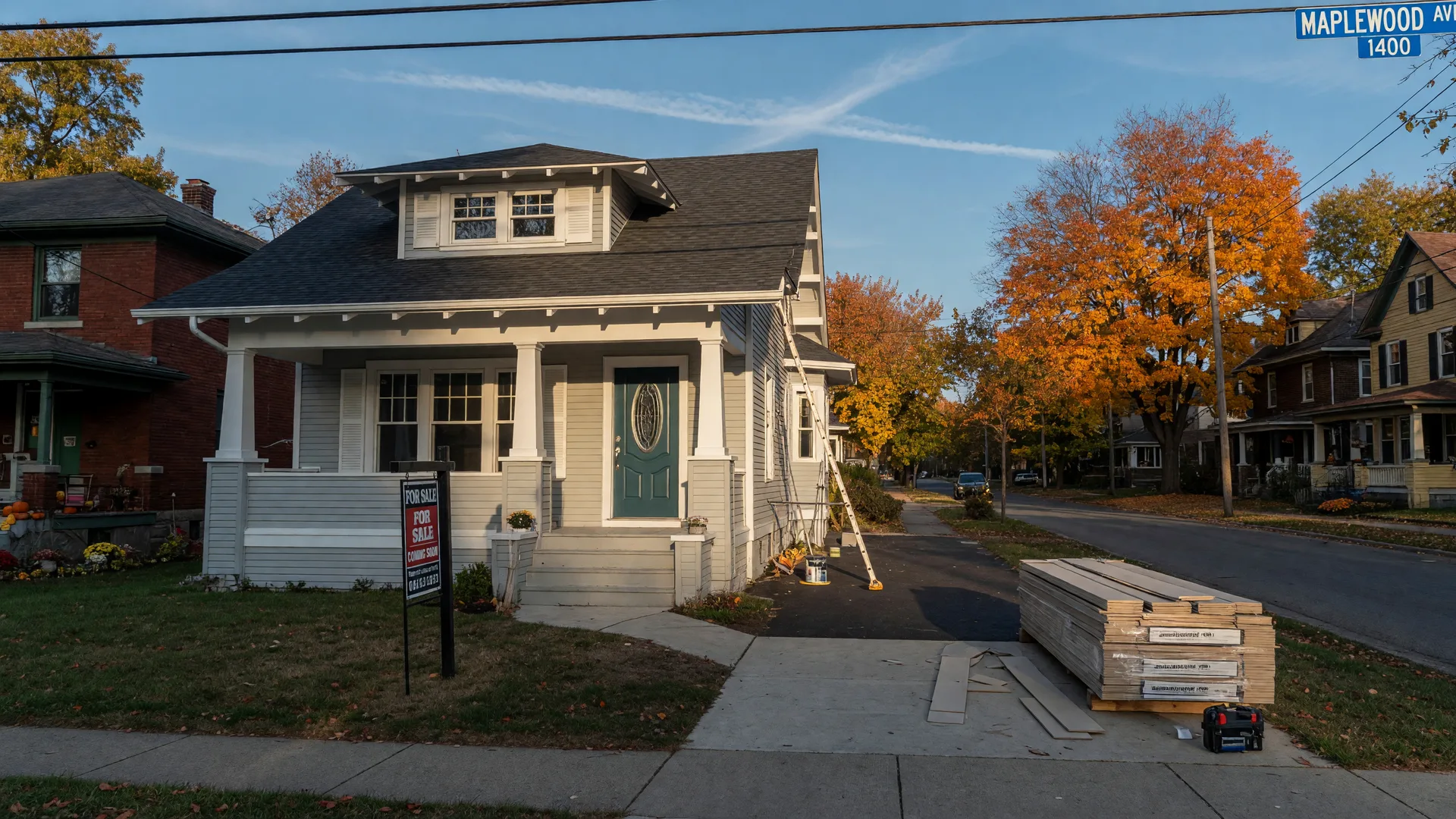
Montgomery County has no separate license, registration, or rule called "flipping": a home bought, renovated, and resold here is treated as an ordinary residential rehab, governed by City of Dayton building permits, Ohio contractor registration rules, and a $3.00 per $1,000 conveyance fee paid on every transfer. The margin story is the more important one. ATTOM data shows Ohio's typical gross flip profit at $54,710 in Q1 2026, down 25 percent from $72,976 a year earlier, while the Dayton metro flipping rate climbed from 10 percent of sales in 2022 to 12.4 percent in 2023, and Federal Reserve Bank of Cleveland data shows investors bought up nearly 30 percent of single-family homes in parts of the county in 2024. Here is the margin track, the fee stack, and the rules that apply, checked October 30, 2026.
How much money are home flippers actually making in Montgomery County in 2026?
The best public record of flip margins is ATTOM Data Solutions, which publishes quarterly home flipping reports with state and metro breakdowns. ATTOM's Q1 2026 state data for Ohio shows 4,115 single-family homes and condos flipped, a 10.8 percent flipping rate, a typical gross profit of $54,710, and a typical gross return on investment of 35.2 percent. A year earlier, the Q1 2025 Ohio gross profit was $72,976 and the ROI was 53.3 percent. That is a 25 percent drop in the typical gross profit and an 18-point drop in ROI in twelve months, and it mirrors what ATTOM reports nationally: the typical national gross profit fell from $74,172 in Q1 2025 to $66,000 in Q1 2026, and the Q2 2026 national margin of 21.5 percent was down from 25.7 percent in Q1.
One transparency note: ATTOM's county-level gross profit figures for Montgomery County itself are published in its paid data products, not in the free public releases, so the cleanest public series is Ohio-level margins plus the Dayton metro flipping rate. The Dayton metro rate is well documented: ATTOM's 2023 year-end report recorded Dayton's flipping rate rising from 10 percent of all home sales in 2022 to 12.4 percent in 2023, one of only a handful of metros where flipping activity increased while the national total plunged. The picture is a volume story with shrinking per-unit profit, which is exactly the margin shift buyers and sellers should watch.
| Measure | Period | Figure | Source |
|---|---|---|---|
| Ohio typical gross flip profit | Q1 2026 vs. Q1 2025 | $54,710 vs. $72,976 (-25%) | ATTOM, state trends |
| Ohio typical gross ROI | Q1 2026 vs. Q1 2025 | 35.2% vs. 53.3% | ATTOM, state trends |
| Ohio flips and flipping rate | Q1 2026 | 4,115 flips, 10.8% of sales | ATTOM, state trends |
| Dayton metro flipping rate | 2022 vs. 2023 | 10.0% vs. 12.4% of sales | ATTOM 2023 year-end report |
| National typical gross profit | 2025 year-end | $65,981, 25.5% ROI, lowest since 2008 | ATTOM 2025 year-end report |
| National typical gross profit | Q1 2026 | $66,000, 25.4% ROI, 165 median days on market | ATTOM Q1 2026 report |
| National flip margin | Q2 2026 | 21.5%, down from 25.7% in Q1 | ATTOM Q2 2026 report |
Is flipping houses legal without a license in Dayton and Montgomery County?
Yes, with a stack of ordinary obligations attached. There is no separate "flipper" license, registration, or special permit in the City of Dayton or Montgomery County, and the county's building-code office confirms homeowners do not register to work on their own property. What a flip does trigger is the same set of rules that applies to any residential rehab: building, electrical, plumbing, and HVAC permits through the City of Dayton Building Inspection Division (or the county in unincorporated areas), inspections against the Ohio Residential Code, licensed trades for electrical, plumbing, and HVAC work, and rental registration with the Montgomery County Auditor if the property is rented rather than resold.
Two state rules matter for flippers specifically. Under Ohio Revised Code Chapter 4722, anyone providing home construction services on a contract over $25,000 must register with the Ohio Attorney General as a home construction service supplier. And under HB 614, signed into law in 2024, contractors performing residential remodeling, repair, or renovation on one-, two-, or three-family dwellings must register with the state under the home improvement contractor program, effective January 1, 2026. Ohio also has no statewide general contractor license: the Ohio Construction Industry Licensing Board (OCILB) licenses electrical, HVAC, plumbing, hydronics, and refrigeration contractors, and those licensed trades must perform that work even on an owner-occupied single-family home. The takeaway for buyers is practical: a properly renovated flip has a permit history on file, and you can pull it before you buy.
What fees and taxes apply every time a Montgomery County flip changes hands?
Every transfer pays the real property conveyance fee, and Montgomery County sits at the high end of the Ohio scale. The county charges the mandatory maximum: a $1.00 per $1,000 state base fee under ORC 319.54(G)(3) plus a $2.00 per $1,000 county permissive transfer tax under ORC 322.02, for a combined $3.00 per $1,000, plus a flat $0.50 fee per parcel, paid to the county auditor before the deed records. A flip bought at $100,000 and resold at $200,000 pays $300.50 on the way in and $600.50 on the way out, roughly $901 in conveyance alone on a $100,000 gross spread. Conveyance is not the only transfer cost, but it is the one fee that is identical on every transaction, which is why it belongs in every flip budget.
| Fee | Rate | On a $100K buy / $200K resale | Authority |
|---|---|---|---|
| State conveyance fee | $1.00 per $1,000 | $100 + $200 = $300 | ORC 319.54(G)(3) |
| County permissive transfer tax | $2.00 per $1,000 | $200 + $400 = $600 | ORC 322.02 |
| Parcel fee | $0.50 per parcel | $0.50 + $0.50 = $1.00 | County auditor |
| Total conveyance on the round trip | $3.00 per $1,000 + $0.50 | ~$901 | Montgomery County Auditor |
| Building / trade permits | City schedule, per permit | Quote from Building Inspection Division | City of Dayton |
| Rental registration (if rented) | Per unit, annual | Montgomery County Auditor | Ohio law, county auditor |
Where are flips actually concentrated in Montgomery County?
The most specific public map comes from the Federal Reserve Bank of Cleveland, reported by the Dayton Daily News in February 2026: investors and corporations bought up nearly 30 percent of single-family homes in the county's investor hotspots in 2024, concentrated in parts of West Dayton, with additional clusters in parts of Kettering and Miami Township. The same reporting quoted a local investor saying a roughly $140,000 to $150,000 renovation could return "minimal, to say the least," which is the margin squeeze in one sentence. Industry compilations add context: one tracker counts about 18 percent of Dayton's roughly 11,528 home sales over the past year as investor flips, and ATTOM-based compilations put Dayton among metros with the highest share of flips purchased all-cash, at 82.8 percent in 2021.
Cash dominance matters for the resale side too. A buyer competing with an all-cash flipper on a bank-owned or distressed listing is a different story from a buyer looking at the renovated product six months later. The renovated flips that reach the MLS in Montgomery County tend to be priced from what the investor actually paid plus the renovation, which is why the resale list price is the single best public window into the flip's economics. County auditor records show the prior sale price on every parcel, so any buyer can compare the resale price to the purchase price recorded months earlier.
| Signal | Figure | Source |
|---|---|---|
| Investor purchase share, county hotspots | Nearly 30% of single-family homes in 2024, led by parts of West Dayton, Kettering, and Miami Twp | Fed Reserve Bank of Cleveland via Dayton Daily News |
| Investor-flip share of Dayton sales | ~18% of ~11,528 sales, trailing 12 months | CleverOffers |
| Share of Dayton flips bought all-cash | 82.8% (2021) | ATTOM data compilation |
| Ohio flipping rate | 10.8% of sales, Q1 2026 | ATTOM |
| Dayton metro flipping rate | 12.4% of sales in 2023, up from 10% in 2022 | ATTOM 2023 year-end report |
How does the Montgomery County Land Bank fit into the flipping supply?
The Montgomery County Land Bank (Montgomery County Land Reutilization Corporation) is the county's biggest public source of low-priced rehab inventory, and its numbers put the entry-price side of the flip math in perspective. Its DIY Renovation Program, now in its 14th year, sells vacant, rehab-ready homes to buyers who may renovate to sell, lease, or occupy, and it completed its 100th DIY renovation on Geneva Road in Dayton in November 2025. Current DIY listings run from about $10,000 to $24,500, with examples like 322 Geneva Rd at $10,000, 747 Heck Ave at $18,500, and 1128 Wilson Dr at $24,500. Its 2024 progress report records 2 renovated homes sold under the DIY program, 6 owner-renovations in the Huffman Historic District, and 40 properties assembled for new construction plus 19 for renovation under the state's Welcome Home Ohio award of $6.96 million, the largest in the state.
Welcome Home Ohio is not a flipping program, and the difference is worth stating plainly: it requires owner-occupancy with a five-year primary-residence deed restriction and income limits, and renovated homes sell at a maximum price of $180,000. That is a deliberate contrast to the open market, where an investor can buy, renovate, and resell without any occupancy or price cap. For buyers, the land bank channel is a source of genuinely affordable renovated inventory; for investors, it is the reminder that the profitable flip in Montgomery County increasingly starts at a $10,000 to $25,000 entry price, not a retail one.
| Program / Item | Detail | Source |
|---|---|---|
| DIY Renovation Program listings | ~$10,000 to $24,500, e.g. 322 Geneva Rd $10,000, 747 Heck Ave $18,500, 1128 Wilson Dr $24,500 | Land Bank property listings |
| 100th DIY renovation | Completed on Geneva Road, Dayton, Nov 2025 | Land Bank newsletter |
| 2024 DIY sales and owner-renovations | 2 homes sold renovated; 6 owner-renovations in Huffman Historic District | 2024 progress report |
| Welcome Home Ohio award | $6.96M for 40 new homes + ~19 to 24 rehabs; max sales price $180,000; 5-year owner-occupancy deed restriction | 2024 progress report, Dayton Daily News |
What do the margin shifts mean for buyers, sellers, and investors in Dayton?
For buyers, the shifting economics are good news on the resale side. When Ohio flip margins compress, renovated inventory tends to list closer to cost, and the county auditor's recorded prior sale is your best tool: compare the resale price to the purchase price recorded months earlier, then ask for the permit history and contractor invoices. A renovated home with clean permits and invoices on file is a documented renovation; one without them is an unverified claim, and it should be priced and inspected that way.
For sellers, a renovated flip on the market alongside your home changes the comp set. If an investor rehabbed a nearby home at a lower cost basis, it can undercut pricing that was set against older sales, and the days-on-market clock starts at the list price, not the investor's cost. Our Dayton seller preparation guide walks through positioning against whatever the comps are, including renovated flips.
For investors, the data points are the discipline. In our practice at Glasshouse Realty, we track Montgomery County sold records, the county auditor's transfer history, and permit activity when we help investors size a flip and when we help buyers evaluate a recently renovated home. The pattern in the 2026 numbers is consistent: a $54,710 typical gross profit on a 165-day median hold leaves no room for surprise repairs, so the flips that still pencil out in Montgomery County are the ones bought at land-bank or distress-level entry prices, renovated against a written budget with permits pulled, and resold with documentation a buyer can verify. When the documentation is missing, we treat the renovation as unverified, and that changes both the value and the inspection approach.
Two more reference points for context: our turnkey vs. fix-and-flip comparison lays out the income-versus-appreciation trade-off for Dayton investors, and the Dayton real estate investor guide covers neighborhoods, cap rates, and financing in one place. For the wider market picture, the Greater Dayton region page tracks prices, inventory, and activity across Montgomery, Greene, and Miami counties.
Buyer, Seller, and Investor Takeaways
- Margin trend: Ohio's typical gross flip profit fell 25% year over year to $54,710 in Q1 2026, ROI dropped from 53.3% to 35.2%, and the Dayton metro flipping rate rose from 10% (2022) to 12.4% (2023). Volume is up, per-unit profit is down.
- Rules: no flipping license exists in Dayton or Montgomery County, but building, electrical, plumbing, and HVAC permits, OCILB-licensed trades, ORC 4722 registration over $25,000, HB 614 contractor registration since January 1, 2026, and rental registration all apply.
- Fee stack: every transfer pays $3.00 per $1,000 conveyance ($1.00 state + $2.00 county) plus $0.50 per parcel; a $100K buy and $200K resale pays about $901 in conveyance alone.
- Where the activity is: investors bought nearly 30% of single-family homes in county hotspots in 2024, led by parts of West Dayton, Kettering, and Miami Township, and about 18% of recent Dayton sales were investor flips, mostly all-cash.
- Land bank: DIY rehabs list from about $10,000 to $24,500, and Welcome Home Ohio rehabs cap at $180,000 with a 5-year owner-occupancy deed restriction; it is affordable housing, not flip inventory.
- Everyone: this is general education about market data and regulations, not legal, tax, title, or financial advice. For a specific transaction, work with your attorney, tax professional, lender, and title company, and verify current permit fees and contractor registration with the City of Dayton Building Inspection Division and the Ohio Attorney General.
Frequently Asked Questions
Do I need a license to flip houses in Dayton or Montgomery County?
No flipping-specific license or registration exists in Dayton or Montgomery County; flips are treated as ordinary residential rehab. What is required: building, electrical, plumbing, and HVAC permits through the City of Dayton Building Inspection Division, licensed trades for electrical, plumbing, and HVAC work, registration as a home construction service supplier for contracts over $25,000 under ORC 4722, and home improvement contractor registration under HB 614, effective January 1, 2026.
How much does it cost to transfer a flipped home in Montgomery County?
Every transfer pays the conveyance fee: $1.00 per $1,000 state base fee plus $2.00 per $1,000 county permissive transfer tax, for a combined $3.00 per $1,000, plus $0.50 per parcel. A flip bought at $100,000 and resold at $200,000 pays about $901 in conveyance alone. The fee is paid to the Montgomery County Auditor before the deed records.
Is flipping houses profitable in Dayton right now?
Ohio's typical gross flip profit was $54,710 in Q1 2026 with a 35.2% ROI, down from $72,976 and 53.3% a year earlier, per ATTOM. The Dayton metro flipping rate rose from 10% of sales in 2022 to 12.4% in 2023, so volume is up while per-unit profit is down. A Dayton Daily News report quoted a local investor saying a roughly $140,000 to $150,000 renovation could return "minimal, to say the least."
What permits do I need to renovate a house in Dayton?
Permits are required for new buildings, additions or modifications to existing buildings, and new or modified electrical, plumbing, or HVAC systems, enforced against the Ohio Residential Code and Ohio Building Code by the City of Dayton Building Inspection Division. An owner who occupies the single-family home may do work under their own permit, but plumbing, electrical, and HVAC work still requires licensed trades. Properties cited as nuisances go through a Special Inspection Permit process.
Can I buy a Montgomery County Land Bank house to flip?
Yes through the DIY Renovation Program, which allows purchasers to renovate and then sell, lease, or occupy, with listings running from about $10,000 to $24,500, such as 322 Geneva Rd at $10,000 and 1128 Wilson Dr at $24,500. The separate Welcome Home Ohio program is not a flip channel: it requires owner-occupancy with a 5-year deed restriction, income limits, and a $180,000 maximum resale price.
Where are investors buying the most homes in Montgomery County?
Federal Reserve Bank of Cleveland data, reported by the Dayton Daily News in February 2026, shows investors and corporations bought nearly 30 percent of single-family homes in the county's investor hotspots in 2024, concentrated in parts of West Dayton with additional clusters in parts of Kettering and Miami Township. About 18 percent of recent Dayton-area sales were classified as investor flips, and the vast majority of Dayton flips are bought all-cash.
Sources (accessed October 30, 2026)
- ATTOM, U.S. Home Flipping Trends by State, Q1 2026 (Ohio: 4,115 flips, 10.8% rate, $54,710 gross profit, 35.2% ROI vs. $72,976 and 53.3% a year earlier)
- ATTOM, Q1 2026 Home Flipping Report (national: 64,348 flips, 8.0% of sales, $66,000 gross profit, 25.4% ROI, 165 median days on market)
- ATTOM, Q2 2026 Home Flipping Report (national: 77,991 flips, 21.5% margin, down from 25.7% in Q1)
- ATTOM, 2025 Year-End Home Flipping Report (297,045 flips, $65,981 typical gross profit, 25.5% ROI, lowest since 2008)
- ATTOM via PR Newswire, 2023 Year-End Home Flipping Report (Dayton metro flipping rate 10% in 2022 to 12.4% in 2023)
- Dayton Daily News, "In Dayton-area hotspots, investors bought up 30% of homes," Feb 12, 2026 (Federal Reserve Bank of Cleveland data; investor ROI quote)
- CleverOffers, Dayton investor-flip share of ~11,528 recent sales (~18%)
- Industry compilation of ATTOM data (Dayton 82.8% all-cash flip share, 2021)
- Montgomery County, Deed Transfer (conveyance fee $3.00 per $1,000 + $0.50 per parcel, ORC 319.54(G)(3) and ORC 322.02)
- City of Dayton, Building Inspection Division (permit requirements, Ohio Residential Code enforcement)
- City of Dayton, Building Inspection FAQs (what requires a permit)
- Ohio contractor licensing summary (no state GC license; OCILB trades; ORC 4722 $25K threshold; HB 614 registration effective Jan 1, 2026)
- Montgomery County Auditor, Residential Rental Registration
- Montgomery County Land Bank, 2024 Progress Report (2 DIY sales, 6 Huffman owner-renovations, 40 + 19 Welcome Home Ohio properties)
- Montgomery County Land Bank, "100 Transformations and Counting" (100th DIY renovation on Geneva Road, Nov 2025)
- Montgomery County Land Bank, Property Listings (322 Geneva Rd $10,000; 747 Heck Ave $18,500; 1128 Wilson Dr $24,500)
- Montgomery County Land Bank, Welcome Home Ohio (5-year owner-occupancy deed restriction, income limits, $180,000 max sales price)
- Dayton Daily News, "Ohio gives Montgomery County Land Bank $7M to build 40 homes, renovate 24"
Social caption: Ohio's typical flip profit fell 25% year over year to $54,710 in Q1 2026, Dayton's metro flipping rate climbed to 12.4% of sales, and investors bought up 30% of homes in parts of Montgomery County. The margin track, the $3-per-$1,000 fee stack, and the Land Bank pipeline from $10,000. Link in bio. #DaytonRealEstate #MontgomeryCounty #FixAndFlip #OhioRealEstate #GlasshouseRealty
Information verified October 30, 2026 · Published October 30, 2026 · Updated October 30, 2026 · Data sources and reporting periods listed above. Fees, program rules, and margins change; confirm current figures with the Montgomery County Auditor, the City of Dayton Building Inspection Division, and the Ohio Attorney General before acting.
Tracking a Montgomery County flip, or buying a recently renovated home?
Send us the address and we will pull the county auditor's transfer history, the prior sale price, and the permit picture before you decide. No pressure, just the numbers, from a team that works across Dayton every week.
Talk to an AgentResearching a flip or a renovated resale in Montgomery County?
We review the sold records, the auditor's prior sale price, and the permit history for the address you are watching, and walk you through what the numbers mean for the offer or the list price.
The margin data we track shows the profitable flips start at land-bank or distress-level entry prices and sell with documentation. We help you verify the renovation before you commit.
Schedule a Consultation