
October 2, 2026 · Utilities & Homeowner Guide
Dayton Suburb Electric Aggregation: Rates From 8.7 to 10.7 Cents vs. AES Ohio's 10.86-Cent Standard Offer
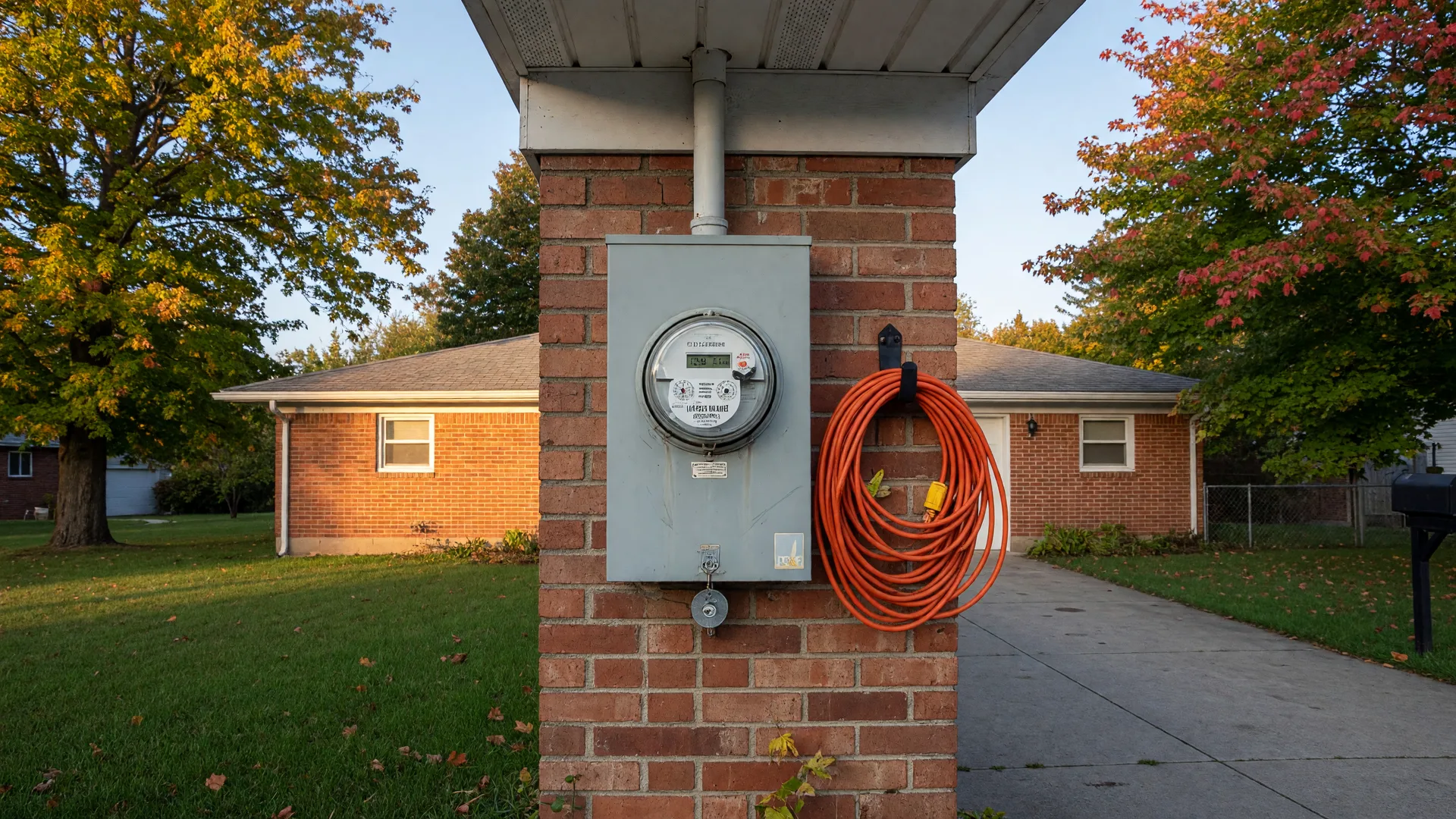
Municipal electric aggregation is a city-run bulk-buying program that sets the generation rate on your AES Ohio bill, and in the Dayton suburbs those rates currently range from about 8.7 cents to 10.7 cents per kilowatt-hour, versus AES Ohio's standard service offer of 10.86 cents per kWh for June 2026 through May 2027. Huber Heights, Fairborn, Kettering, Centerville, Troy, Beavercreek, and Riverside all run opt-out aggregation programs, and most are saving a typical home roughly $14 to $20 a month on the supply portion of the bill. Here is who runs each program, what the current published rates are, and how the opt-out mechanics work.
The one-line version: your city, not your utility, negotiates the price of the electricity itself, while AES Ohio keeps delivering it and billing you. That split is why two identical houses a few miles apart can carry different supply rates, and it is the single most common utility question we hear from buyers comparing suburbs in Montgomery and Greene counties. This guide covers the legal framework, the current rates in each program city, the savings math on a typical bill, and the honest caveats, including the cities where the aggregation rate reset close to, or barely below, the utility's standard offer.
What Is Municipal Electric Aggregation and How Does It Work in Ohio?
Municipal electric aggregation is authorized by Ohio Revised Code Section 4928.20. A city's legislative authority adopts an ordinance to aggregate the electric load of households and small businesses in its borders, then negotiates a supply contract with a competitive retail electric supplier. The program covers only the generation and supply portion of the bill, the part that pays for the electricity itself. AES Ohio, the distribution utility (formerly Dayton Power & Light), continues to own the wires, deliver the power, read the meter, and send the bill, and its delivery charges are unchanged by aggregation.
The crucial feature of the programs in the Dayton area is that they are opt-out, not opt-in. Under ORC 4928.20, an opt-out program has to be approved by voters on a general or special election ballot before it can operate, and after approval the city must file a plan of operation and governance and be certified by the Public Utilities Commission of Ohio (PUCO). Once running, every household is automatically enrolled unless it declines. Before enrollment, the city or its supplier must mail a written opt-out notice that discloses the price per kilowatt-hour, all fees and charges, and exactly how to decline, under PUCO rules 4901:1-21-16 and 4901:1-21-17.
Customers can opt out any time, and the law guarantees the right to opt out every three years without penalty. There is also a PUCO-run electric do not aggregate list: anyone who adds their name to it has to be removed from a program's enrollment at least 60 days before opt-out notices are mailed, and you can add yourself by calling PUCO at 1-800-686-7826 or filing the form on the PUCO website. If you opt out, you revert to AES Ohio's standard service offer, the default supply rate the utility charges customers who do not shop, unless you sign up with a competitive supplier on your own.
Which Dayton Suburbs Have an Electric Aggregation Program Right Now?
Seven cities in our Dayton coverage area have active aggregation programs with published rates, administered by two different organizations. The Sustainable Ohio Public Energy Council (SOPEC) runs the programs in Huber Heights and Riverside with supplier AEP Energy, and the Miami Valley Communications Council (MVCC) runs the programs in Fairborn, Kettering, Centerville, and Troy with supplier Constellation NewEnergy. Beavercreek runs its own voter-approved program, also currently with Constellation. MVCC's coalition also includes Miamisburg, Vandalia, West Carrollton, Moraine, Englewood, Clayton, Germantown, and Trotwood, so confirm the current rate with each city's finance or utilities office rather than assuming a single coalition rate.
| City | Program administrator | Supplier | Published rate (per kWh) | Contract status |
|---|---|---|---|---|
| Huber Heights | SOPEC | AEP Energy | 8.951 cents, 100% renewable | Rate ran Oct. 1, 2025 through the June 2026 meter read; confirm the current reset rate with the city or SOPEC |
| Fairborn | MVCC | Constellation | 9.04 cents | 12-month contract, Jan. 1 through Dec. 31, 2026 |
| Kettering | MVCC | Constellation | 9.049 cents | Fixed rate, Jan. through Dec. 2026 |
| Centerville | MVCC | Constellation | 9.049 cents | Fixed rate, Jan. through Dec. 2026 |
| Troy | MVCC | Constellation | 9.049 cents (9.34 cents renewable opt-in) | 12-month contract, Jan. 1 through Dec. 31, 2026 |
| Beavercreek | City program | Constellation | 8.699 cents (9.021 cents renewable opt-in) | 16-month contract ran Aug. 2025 through Aug. 2026; confirm renewal status with the city |
| Riverside | SOPEC | AEP Energy | 10.691 cents, 100% renewable | New rate effective with the June 2026 reset, per AEP Energy's opt-out notice |
Two things jump out of that table. First, every current aggregation rate sits below AES Ohio's 10.86-cent standard offer, but the gap is not uniform: Beavercreek's 8.699 cents is more than two cents under, while Riverside's post-reset 10.691 cents is barely a sixth of a cent under. Second, the rates are fixed for a term, then reset, so the number printed on today's opt-out letter is not the number that will be printed on next year's. That is the single most important thing to understand before you assume your city's program is saving you money.
How Much Does Aggregation Save on a Typical AES Ohio Bill?
The savings math is straightforward because the comparison is apples to apples: both the aggregation rate and the standard service offer are prices for the same generation supply, and AES Ohio's delivery charges are identical either way. The Ohio Office of the Consumers' Counsel (OCC) puts a typical Ohio household at 750 to 1,000 kilowatt-hours per month, and Dayton-area estimates cluster near 900 to 1,000 kWh, so we use 900 kWh as the working figure below.
| City rate | Gap vs. 10.86-cent SSO | Estimated monthly saving | Estimated annual saving |
|---|---|---|---|
| Beavercreek, 8.699 cents | 2.161 cents | About $19.45 | About $233 |
| Huber Heights, 8.951 cents | 1.909 cents | About $17.18 | About $206 |
| Fairborn, 9.04 cents | 1.82 cents | About $16.38 | About $197 |
| Kettering, Centerville, Troy, 9.049 cents | 1.811 cents | About $16.30 | About $196 |
| Riverside, 10.691 cents | 0.169 cents | About $1.52 | About $18 |
Two context points make these numbers sharper. First, AES Ohio's standard offer was 9.45 cents per kWh for June 2025 through May 2026 and jumped to 10.86 cents for June 2026 through May 2027, a change the PUCO flagged publicly. That increase is what widened the gap for most aggregation programs this year. Second, the standard offer includes a separate, lower rate for qualifying electric-heating residential customers: 9.18 cents per kWh for November 2026 through May 2027. If you heat with electricity, your default rate is already below most aggregation rates, so the program may not save you anything on winter months. Check your heating type before you assume the comparison applies to you.
One more honesty note: the aggregation rate is fixed for the contract term, while the standard offer can move at each June reset. A program that beats the standard offer by two cents today can trail it after a reset, which is exactly what happened in Riverside this year. Treat every rate in this guide as a snapshot verified on October 2, 2026, and confirm the current number with your city before you make a decision based on it.
Huber Heights and Fairborn: Two Programs, Two Ways of Buying Power
The two cities named in the question this guide answers show how differently two aggregation programs can be built. Huber Heights has run its program since December 2017, with voters re-authorizing it, and it buys through SOPEC, a council of governments that negotiates on behalf of member communities across Ohio. Its published rate was 8.951 cents per kWh with 100 percent renewable energy, effective October 1, 2025 through the June 2026 meter read, when the rate was scheduled to reset. Customers who want out call AEP Energy directly, and the city publishes the opt-out letter and terms on its website.
Fairborn buys through MVCC, a Miami Valley council of governments, and its current 12-month contract with Constellation runs at 9.04 cents per kWh from January 1 through December 31, 2026. Fairborn's previous contract is the cautionary tale: under its prior supplier, the rate was 6.57 cents per kWh for October 2023 through December 2025, a number that now looks almost impossibly low against today's 10.86-cent standard offer. Aggregation rates swing with the wholesale market and the contract cycle, and the swing in Fairborn alone is more than three cents per kWh across two contracts.
For buyers comparing the two cities, the practical difference is not the administrator, it is the timing of the rate. Huber Heights' rate resets in June on SOPEC's cycle; Fairborn's resets in January on MVCC's cycle. A home bought in one city in October inherits a rate that changes in eight months, while the same month in the other city inherits one that changes in three. Neither is better or worse, but the contract calendar is a real, verifiable difference between two otherwise similar suburbs.
When the Contract Ends: Rate Resets, Renewals, and the Do Not Aggregate List
Every aggregation rate in Table 1 is a snapshot of a fixed-term contract, and the term ending is where the real risk lives. Riverside is the current example: its SOPEC rate was 9.333 cents per kWh through June 2026, and the June reset moved it to 10.691 cents, per AEP Energy's opt-out notice. That is still a hair under the 10.86-cent standard offer, but it is a much smaller advantage than the two-cent gaps in Beavercreek or Huber Heights, and it shows why the phrase "aggregation saves you money" needs a date stamp.
Beavercreek's 16-month Constellation contract at 8.699 cents ran through August 2026, and as of this writing the city had not published a renewal rate, so anyone in Beavercreek should confirm the current contract with the city before relying on the old number. The same applies to Huber Heights after its June 2026 reset. This is not a defect in the programs, it is how they work: the city re-negotiates, the new rate is disclosed in a fresh opt-out notice, and residents who do not like the new number can leave.
The exit tools are worth repeating because they are the consumer protection built into ORC 4928.20: you can opt out at any time, you are guaranteed a penalty-free opt-out every three years, and the PUCO do not aggregate list keeps you out of future enrollments entirely. If you opt out, AES Ohio's standard service offer becomes your supply rate automatically, so you never face a gap in service. And if you are on the do not aggregate list, the aggregator must remove you at least 60 days before mailing opt-out notices, which is why adding your name early matters if you are closing on a home in a program city.
What Dayton Buyers and Sellers Should Know About Aggregation
In our experience helping buyers compare monthly costs across Dayton suburbs, the aggregation question comes up whenever two similar homes sit in different cities, because the supply rate is set by the city, not the utility. Here is how we plan for it in practice. On the showing side, we ask which city bills the address and whether that city runs an aggregation program, then we pull the current published rate and the contract end date before we talk about a buyer's future electric bill, because a home in Beavercreek and a home in Riverside can differ by nearly $18 a month on supply alone at current rates. On the selling side, we flag the aggregation rate and its opt-out status as a documented utility feature worth mentioning in the disclosures, and we note the supply line on the current bill so the buyer sees the actual number.
For homeowners, the checklist is short: find the supply line on your AES Ohio bill, compare its rate to the standard service offer on the Energy Choice Ohio website, check your city's published aggregation rate and contract end date, and decide whether staying enrolled beats the default. For buyers, add two questions to your pre-offer list: does this city run an aggregation program, and what is the current rate and when does it reset? That pair of questions tells you more about the monthly cost of the house than the listing price per square foot ever will.
Buyer and Seller Takeaways
- Homeowners: compare the supply rate on your AES Ohio bill against the standard service offer on the Energy Choice Ohio website, and check your city's aggregation rate and contract end date before you assume the program is saving you money.
- Buyers: ask which city bills the address, whether it runs an aggregation program, and what the current rate and reset date are, because the supply rate can differ by nearly $18 a month between program cities at current published rates.
- Sellers: list the aggregation rate and opt-out status as a documented utility feature and share the supply line from the current bill so buyers can see the real number.
- Electric-heat customers: AES Ohio's standard offer includes a lower electric-heating rate of 9.18 cents per kWh for November 2026 through May 2027, below most aggregation rates, so check your heating type before comparing.
- Everyone: this is general education, not legal, tax, or financial advice. For a specific property or account, confirm the current rate with your city, check the PUCO do not aggregate list, and consult your attorney, tax advisor, or utility as your situation warrants.
If you are weighing a home in the county, our Montgomery County market coverage maps the communities and price points, and our guide to sewer deduct meters covers the other utility cost that varies street by street in the same cities. Our cost of living comparison puts utility bills next to taxes and housing across Dayton, Columbus, Cincinnati, and Cleveland, and if you are just starting the search, our buyer guide walks through the full checklist, from utility questions to closing.
Frequently Asked Questions
What is municipal electric aggregation in Ohio?
A city-run bulk-buying program authorized by Ohio Revised Code Section 4928.20. The city negotiates a supply contract with a competitive supplier for everyone in its borders, and the negotiated rate replaces the utility's standard service offer on the generation portion of the bill. Opt-out programs must be approved by voters and certified by the PUCO, and customers are automatically enrolled unless they decline.
Which Dayton suburbs have electric aggregation programs?
Huber Heights and Riverside through SOPEC with AEP Energy, and Fairborn, Kettering, Centerville, and Troy through MVCC with Constellation, plus Beavercreek's own voter-approved program with Constellation. MVCC's coalition also includes Miamisburg, Vandalia, West Carrollton, Moraine, Englewood, Clayton, Germantown, and Trotwood, so confirm the current rate with each city.
How much does electric aggregation save on an AES Ohio bill?
At the rates published as of October 2026 and a typical 900 kWh monthly use, about $16 to $19 a month, or $196 to $233 a year, in Beavercreek, Huber Heights, Fairborn, Kettering, Centerville, and Troy, versus AES Ohio's 10.86-cent standard offer. Riverside's post-reset rate of 10.691 cents saves only about $1.50 a month, and electric-heat customers on the 9.18-cent standard heating rate may save nothing at all.
What is AES Ohio's standard service offer rate?
10.86 cents per kWh for June 1, 2026 through May 31, 2027, up from 9.45 cents for the prior year, per the PUCO and the Energy Choice Ohio website. Qualifying electric-heating residential customers have a lower rate of 9.18 cents per kWh for November 1, 2026 through May 31, 2027.
Can I opt out of my city's electric aggregation program?
Yes. You can opt out at any time, and Ohio law guarantees a penalty-free opt-out every three years. Opting out reverts you to AES Ohio's standard service offer unless you choose another competitive supplier. You can also add your name to the PUCO electric do not aggregate list by calling 1-800-686-7826, which keeps you out of future enrollments.
Does aggregation cover my whole AES Ohio bill?
No. Aggregation covers only the generation and supply portion of the bill. AES Ohio still delivers the electricity, reads the meter, and sends the bill, and its delivery charges are the same whether you are on an aggregation rate or the standard service offer. Compare only the supply lines when you check whether your city's rate beats the default.
Sources
- Energy Choice Ohio, AES Ohio Price to Compare (standard service offer 10.86 cents per kWh, June 2026 through May 2027; electric-heating rate 9.18 cents)
- PUCO, Alert on AES Ohio Standard Service Offer Price Changes (June 2026 rate change from 9.45 to 10.86 cents)
- Ohio Revised Code Section 4928.20, Local Aggregation of Retail Electric Loads (ordinance authority, ballot approval, opt-out programs, three-year opt-out right)
- Ohio Administrative Code Rule 4901:1-21-16, Opt-Out Governmental Aggregation (plan of operation and governance, PUCO certification)
- Ohio Administrative Code Rule 4901:1-21-17, Opt-Out Disclosure Requirements (price per kWh, fees, and opt-out procedure in the written notice)
- PUCO, Government Aggregation (program overview and oversight)
- PUCO, Electric Do Not Aggregate List (1-800-686-7826, 60-day removal before opt-out mailings)
- City of Huber Heights, Electric Aggregation Program (program since December 2017, SOPEC administration, opt-out via AEP Energy)
- City of Huber Heights, 2025 SOPEC Opt-Out Letter and Terms (8.951 cents per kWh, 100% renewable, effective Oct. 1, 2025 through June 2026 meter read)
- SOPEC, City of Huber Heights Rate Page (program rate and renewable content)
- City of Fairborn, Electric Aggregation (MVCC program, Constellation contract)
- City of Fairborn, New Electric Aggregation Rate Announced (9.04 cents per kWh, Jan. 1 through Dec. 31, 2026, below the AES Ohio standard rate)
- City of Kettering, 2026 Electric Aggregation Program Summary (Constellation, 9.049 cents per kWh, January through December 2026)
- City of Centerville, Electric Aggregation (MVCC program, Constellation supplier)
- City of Troy, Energy Aggregation Information (Constellation, 9.049 cents per kWh, Jan. 1 through Dec. 31, 2026; 9.34-cent renewable opt-in)
- City of Beavercreek, Electric Aggregation Opt-Out Letter with Constellation (8.699 cents per kWh, 9.021-cent renewable opt-in, August 2025 through August 2026)
- City of Riverside, Aggregation (SOPEC program, AEP Energy supplier)
- AEP Energy, SOPEC Riverside Aggregation Opt-Out Notice (10.691 cents per kWh, 100% renewable, effective with the June 2026 reset)
- Miami Valley Communications Council, Electric Supply and Aggregation (coalition program administrator)
- Ohio Consumers' Counsel, What's Driving Your Electric Bill (typical Ohio household use of 750 to 1,000 kWh per month)
- Rates, contract terms, and program status reviewed October 2, 2026.
Share This Post
Suggested social caption
"The supply rate on your AES Ohio bill is set by your city, not just your utility. Dayton suburb aggregation programs run from 8.7 to 10.7 cents per kWh versus AES Ohio's 10.86-cent standard offer, and most save a typical home $14 to $20 a month. Here is how Huber Heights, Fairborn, Kettering, Centerville, Troy, Beavercreek, and Riverside compare, from Glasshouse Realty."
Published October 2, 2026 · Updated October 28, 2026 · Information verified on October 2, 2026 against the sources listed above. Rates, contract terms, and program status change; confirm the current rate with your city and the PUCO before you act.
Buying or selling in the Dayton suburbs?
Get a no-pressure, data-backed read on the Dayton market, including the utility costs that show up in your monthly budget, the communities that fit your life, and the questions to ask before you write an offer. We know Huber Heights, Fairborn, Kettering, Centerville, Beavercreek, and every corner of the Miami Valley.
Talk to an AgentComparing utility costs across Dayton suburbs?
Whether you are buying, selling, or weighing two communities, a Glasshouse agent can show you the real monthly cost picture, from aggregation rates to property taxes to water and sewer.
No pressure, no guesswork. Just honest, local answers from a team growing across Dayton and the Miami Valley.
Schedule a Consultation