
October 2, 2026 · Commute Guide
I-75 vs. I-675 Into Downtown Dayton: Which Corridor Gets You to Work Faster?
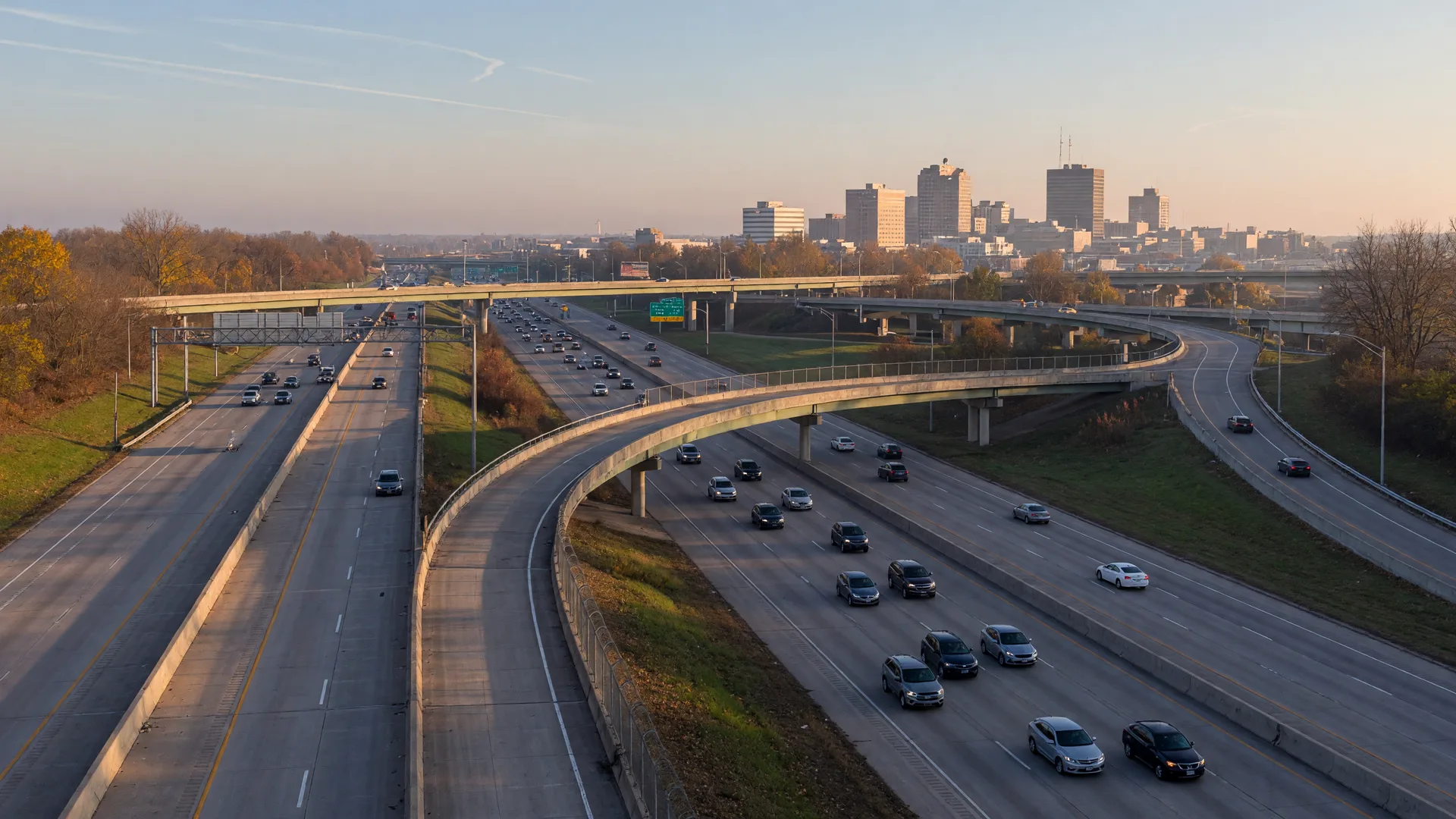
I-75 is the direct north-south route into downtown Dayton, and Interstate 675 is the 26.5-mile eastern bypass that loops around it. For most downtown commuters, the faster morning drive is the one that avoids the northbound I-75 bottleneck between U.S. 35 and the I-70 interchange, which is why an eastern suburb like Centerville can match southern I-75 suburbs on published estimates despite sitting farther from the skyline. Here is the street-level breakdown: morning drive times for every community on either side of the split, the ODOT projects changing both corridors, and the 2026 price picture for each commute zone.
Where exactly do I-75 and I-675 split, and which suburbs sit on each corridor?
I-75 runs north-south straight through downtown Dayton. North of the city it serves Vandalia, Tipp City, and Troy in Montgomery and Miami counties; south of the city it serves Kettering, West Carrollton, and Miamisburg in Montgomery County and Springboro in Warren County. If your address is on the I-75 line, your downtown route is a straight shot on the same highway.
Interstate 675 is a 26.5-mile auxiliary interstate that forms an eastern bypass of Dayton through Montgomery, Greene, and Clark counties. It runs from I-75 near Miamisburg in the south to I-70 and State Route 4 near Fairborn and Medway in the north, and it opened in 1987. It serves Miamisburg, Centerville, Kettering, Beavercreek, and Fairborn. The interchanges that matter for downtown commuters are Exit 2 at SR 725 (Miamisburg and Centerville), Exit 4 at SR 48 (Kettering and Centerville, the Wilmington Pike interchange), Exit 10 at Dorothy Lane and Indian Ripple Road (Kettering), Exit 13 at U.S. 35 (Xenia, Dayton, and Beavercreek), and Exit 24 at SR 444 (Wright-Patterson AFB and Fairborn).
U.S. 35 is the expressway that carries the eastern side of the metro straight into downtown, which is why Beavercreek and Xenia commuters often skip I-75 entirely. The practical takeaway: the corridor that is fastest depends on where in the metro you start, not on which highway has the bigger name.
How long is the morning commute from each corridor into downtown Dayton?
Published drive-time estimates for the morning peak put the shortest downtown commutes on the I-75 south corridor, where Kettering sits only about five miles from the city center. Northbound I-75 is the congested direction in the morning, with traffic building after roughly 7:15 a.m., so peak drives on I-75 routes typically run 10 to 20 minutes longer than free-flow times. I-675 moves more freely as a bypass, but its Wilmington Pike interchange is the corridor's known pinch point.
Table: Estimated morning drive times into downtown Dayton by corridor, plus 2026 median price context. Times are published estimates for typical morning peak traffic; prices are Glasshouse Realty market-watch medians and public listing data, accessed October 2, 2026.
| Community | Corridor | Route into Downtown | Morning Peak Drive | 2026 Median Price |
|---|---|---|---|---|
| Kettering | I-75 (south) | I-75 N | 9-12 min | ~$247K |
| Vandalia | I-75 (north) | I-75 S | 12-15 min | ~$214K |
| West Carrollton | I-75 (south) | I-75 N | 10-15 min | ~$169K projected |
| Centerville | I-675 | I-675 N to U.S. 35 W | 15-20 min | ~$338K |
| Miamisburg | I-75 (south) | I-75 N | 15-20 min | ~$273K |
| Tipp City | I-75 (north) | I-75 S | 18-21 min, under 30 at peak | ~$295K |
| Springboro | I-75 (south) | I-75 N | 20-25 min | ~$431K |
| Beavercreek | I-675 | U.S. 35 W | 15-25 min | ~$362K |
| Troy | I-75 (north) | I-75 S | ~25 min, under 30 at peak | ~$262K |
A few notes on the numbers. Kettering's 9 to 12 minute window is the shortest downtown drive in the metro on published estimates because the city sits directly on I-75 about five miles from the center. Beavercreek's range is wider because the route depends on which side of the city you start from: the western sections near U.S. 35 run closer to 15 minutes, while the eastern edge near the WPAFB boundary stretches toward 25. And Troy's commute stays under 30 minutes at peak on local commuter reports despite being about 20 miles out, because the northbound flow into Dayton is lighter than the southbound flow out.
Why is northbound I-75 the morning bottleneck, and what did the ODOT modernization fix?
The historic problem on I-75 through downtown was not volume alone. The Ohio Department of Transportation (ODOT) and the Miami Valley Regional Planning Commission (MVRPC) documented weaving zones, left-hand entrances and exits, and poor geometry along the 3.7-mile stretch from south of U.S. 35 to north of State Route 4. ODOT's I-75 Modernization Project, completed on September 22, 2016 after about a decade of work and more than $300 million in investment, rebuilt that stretch with three continuous lanes in each direction, removed the left-hand entrances and exits, improved the northbound curve at the I-75/SR 4/Main Street interchange from 45 to 60 mph, and added a braided ramp that eliminated the worst weaving movements. ODOT District 7 described the result as a smoother, less congested commute.
The corridor is not done changing. ODOT currently lists an active Interstate 75 Reconstruction in Dayton project between Needmore Road and Leo Street, so drivers on the northern approach should expect construction-related delays through the work window. For homebuyers, the takeaway is that I-75 is a mature, rebuilt corridor with occasional active projects, not a highway that fails at rush hour the way it did in the 2000s.
What does the I-675/Wilmington Pike project mean for Centerville and Kettering commuters?
The I-675/Wilmington Pike interchange (Exit 4) in Centerville has been the eastern corridor's congestion and crash hotspot for years. ODOT has approved a five-phase project, roughly $71 million, to rebuild it as a diverging diamond interchange (project ID 115160), with construction currently expected from 2028 to 2030. Until then, the interchange remains the pinch point on I-675, which matters most to Centerville and Kettering commuters who enter the bypass at SR 48. If your work center is downtown and you are choosing between the two corridors, the I-675 route is the one with a scheduled major rebuild ahead, while the I-75 route is the one with active reconstruction already underway.
How does the corridor choice change what you pay for a home?
The two corridors span very different price bands in 2026. The I-75 corridor runs from West Carrollton's projected median home value near $169,000 up to Springboro's median near $431,000, a spread of more than $260,000 along one highway. The I-675 corridor is tighter, from Kettering's median near $247,000 to Beavercreek's near $362,000.
Table: 2026 median price context by corridor. Prices are Glasshouse Realty market-watch medians, Redfin median sale prices, and Montgomery County community profile projections, accessed October 2, 2026. Medians vary by source and month; treat them as directional, not appraisals.
| Corridor | Community | 2026 Median Price | Source |
|---|---|---|---|
| I-75 (south) | West Carrollton | ~$169K | Montgomery County 2026 profile |
| I-75 (north) | Vandalia | ~$214K | Redfin median sale price |
| I-675 | Kettering | ~$247K | Glasshouse market watch |
| I-75 (north) | Troy | ~$262K | Glasshouse market watch |
| I-75 (south) | Miamisburg | ~$273K | Redfin median sale price |
| I-75 (north) | Tipp City | ~$295K | Glasshouse market watch |
| I-675 | Centerville | ~$338K | Glasshouse market watch |
| I-675 | Beavercreek | ~$362K | Glasshouse market watch |
| I-75 (south) | Springboro | ~$431K | Glasshouse market watch |
In our experience helping buyers weigh the two corridors, the price gap between the I-75 south corridor and the I-675 corridor is the first thing that surprises out-of-town buyers. West Carrollton and Vandalia offer the lowest entry points, while Beavercreek and Centerville carry the highest medians on the eastern loop. The commute math and the budget math do not point the same direction for everyone, which is exactly why we map both before the first showing: a buyer who needs a 12 minute drive and a buyer who needs a 20 minute drive can end up in very different communities at the same price.
Practical buyer and seller takeaways
For buyers. Test the route at the time you will actually drive it, not on a weekend. Northbound I-75 builds after roughly 7:15 a.m., so a Saturday drive tells you nothing about the Tuesday commute. If your office is downtown, map the door-to-badge route on both options: I-75 direct versus I-675 to U.S. 35. And check the active ODOT construction on I-75 between Needmore Road and Leo Street, plus the scheduled I-675/Wilmington Pike rebuild, before you commit to a corridor.
For sellers. Price against your corridor's median, not the metro average. A home in West Carrollton competes with other I-75 south inventory near $169,000, while a Beavercreek listing competes near $362,000, and buyers researching both corridors will know the difference. In our experience, listing a home with the actual morning drive time to downtown in the description draws more serious buyers than a generic "close to highways" line, because commute data is what out-of-town buyers search for first.
For the full relocation picture, see our moving to Dayton guide, our WPAFB commute guide for the base gate breakdown, and our Dayton commuter neighborhood comparison for employment centers beyond downtown.
Frequently Asked Questions
Is I-675 faster than I-75 into downtown Dayton in the morning?
Not always. Northbound I-75 is the congested direction in the morning, so southern I-75 suburbs like Kettering and West Carrollton still make the shortest downtown drives on published estimates, around 9 to 15 minutes. I-675 moves more freely as a bypass, but its Wilmington Pike interchange is the corridor's known pinch point, and the eastern route into downtown adds miles even when traffic is light. The fastest corridor depends on where you start, so map your exact address at the time you will drive.
Which suburbs are on the I-75 corridor, and which are on I-675?
I-75 serves Vandalia, Tipp City, and Troy north of Dayton, and Kettering, West Carrollton, Miamisburg, and Springboro south of it. I-675, the 26.5-mile eastern bypass from I-75 near Miamisburg to I-70 and SR 4 near Fairborn, serves Miamisburg, Centerville, Kettering, Beavercreek, and Fairborn. Kettering and Miamisburg sit on both, which is why their commutes can use either highway.
What is the Dayton Split and why does it slow down I-75?
The Dayton Split is the I-75/I-70 interchange area north of downtown where the two interstates meet. The historic slowdowns came from weaving zones, left-hand entrances and exits, and poor geometry on the 3.7-mile stretch from south of U.S. 35 to north of SR 4. ODOT's I-75 Modernization Project, completed in September 2016, rebuilt it with three continuous lanes each way and removed the left-hand ramps, and ODOT now lists active reconstruction work between Needmore Road and Leo Street.
When does the I-675/Wilmington Pike diverging diamond interchange open?
ODOT has approved the roughly $71 million diverging diamond project at the I-675/Wilmington Pike interchange (project ID 115160) with construction currently expected from 2028 to 2030. Until it opens, the interchange remains the eastern corridor's congestion hotspot, so Centerville and Kettering commuters should plan extra time at Exit 4 during peak hours.
What is the fastest route from Beavercreek to downtown Dayton?
U.S. 35 west is the most direct expressway from Beavercreek into downtown, and published estimates put the morning drive at roughly 15 to 25 minutes depending on which side of the city you start from. The alternative, I-675 north to I-75, adds miles and runs closer to 25 to 30 minutes at peak. Western Beavercreek sections near the U.S. 35 interchange have the shortest drives.
How much does corridor choice change 2026 home prices?
A lot. The I-75 corridor spans from West Carrollton's projected median home value near $169,000 to Springboro's median near $431,000, while the I-675 corridor runs from Kettering near $247,000 to Beavercreek near $362,000. Medians vary by source and month, so use them as directional context and verify current pricing with a local agent and recent sales in the specific neighborhood.
Sources
- Miami Valley Regional Planning Commission: I-75 traffic flow improvements
- ODOT: Interstate 75 Reconstruction in Dayton (Needmore Road to Leo Street)
- ODOT: I-675/Wilmington Pike study and improvements (project 115160)
- Dayton.com: I-75 construction is finally finished (2016)
- AARoads: Interstate 675 Ohio route and interchange guide
- Redfin: Miamisburg housing market data
- Montgomery County: West Carrollton community profile 2026
- Redfin: Tipp City housing market data
Reporting period: ODOT project records, MVRPC congestion management data, route guides, and published 2026 price reports, accessed October 2, 2026. This guide is general market education, not legal, tax, financial, or mortgage advice. Verify current traffic conditions, project timelines, and school enrollment with ODOT, the relevant districts, and qualified professionals for your specific situation.
Social caption: New commute guide: I-75 vs. I-675 into downtown Dayton. Real morning drive times from Troy, Tipp City, Vandalia, Kettering, Miamisburg, Centerville, Beavercreek, and Springboro, with 2026 price data for both corridors. Link in bio. #DaytonRealEstate #DaytonCommute #GlasshouseRealty
Published October 2, 2026 · Updated October 28, 2026
Choosing between the I-75 and I-675 corridors?
Tell us your work address and your budget, and we will map the morning drive from every community on both corridors before you look at a single home. No pressure, just data you can drive to.
Talk to an AgentMapping your Dayton commute?
Whether you are buying, renting, or just weighing the I-75 versus I-675 trade-off, a Glasshouse agent can map your drive time, your budget, and your timeline in one conversation.
We help buyers compare commute corridors across the metro every week, from West Carrollton starter homes to Beavercreek family houses.
Schedule a Consultation