
October 21, 2026 · Oregon District & St. Anne's Hill Comparison
Oregon District vs. St. Anne's Hill: 84 vs. 75 Walk Scores, the 12-Block Fifth Street Core vs. the 14-Block Brick Residential Grid, and Which of the 20% Federal and 25% Ohio Historic Tax Credits Actually Apply
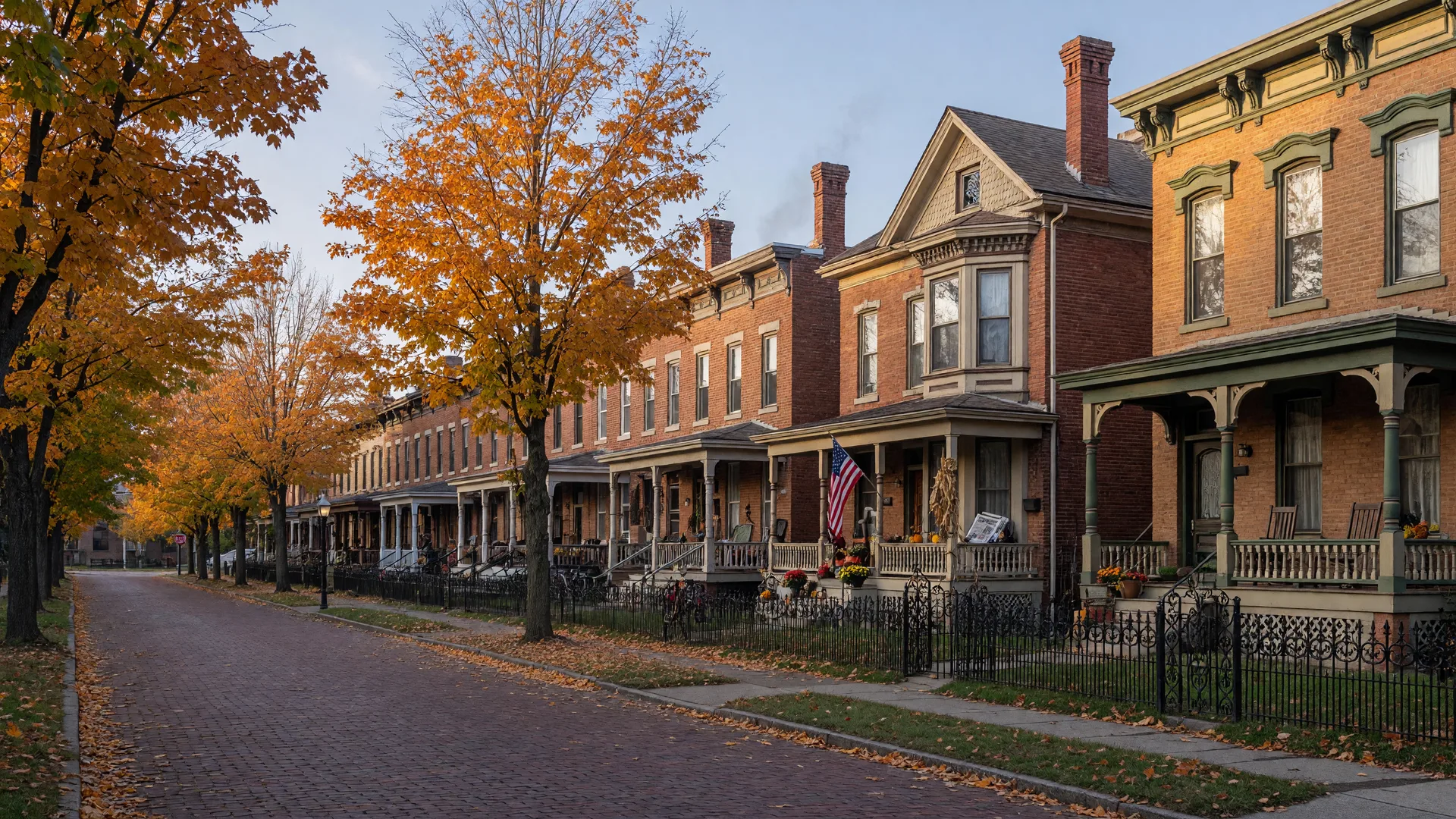
Oregon District and St. Anne's Hill are Dayton's two oldest historic neighborhoods, side by side on the east edge of downtown, but they are structurally different. The Oregon District, locally designated in 1972 and listed on the National Register of Historic Places in 1975, is a roughly 12-block mixed-use canal-era core where East Fifth Street carries restaurants, bars, and the Neon cinema beneath Federal, Greek Revival, Italianate, and Queen Anne homes built from the 1820s through 1915. St. Anne's Hill, locally designated in 1974 and listed on the National Register in 1986, is a predominantly residential, roughly 14-block grid of late-19th-century brick Victorian homes built by German tradesmen. Walk Scores run 84 and 75, and both neighborhoods sit inside Dayton's local historic overlay, where the Landmark Commission reviews exterior changes through Certificates of Appropriateness.
In our experience helping buyers and sellers in Dayton's historic districts, the two neighborhoods attract different households for structural reasons, not just taste. Oregon District buyers want the mixed-use Fifth Street scene and the most walkable block in the Dayton metro; St. Anne's Hill buyers want a quieter, residential, tree-lined grid a mile from downtown with the same preservation rules. This guide is a street-level comparison of layout, walkability, restoration rules, and historic tax credits, verified against the City of Dayton, the National Register, the Ohio Department of Development, and published market and walkability sources on October 21, 2026. It is general educational information, not legal, tax, title, or mortgage advice; confirm current rules with the City of Dayton's Planning and Community Development Department and with qualified professionals before you act.
How do the Oregon District and St. Anne's Hill layouts compare structurally?
The Oregon Historic District was platted in 1829 alongside the Miami and Erie Canal, whose opening that year made it Dayton's first real urban suburb, settled largely by German-speaking immigrants who arrived by canal boat. Its National Register listing (reference 75001506) describes a roughly 12-block district between Patterson Boulevard and Wayne Avenue, north to Gates Street and south to US-35, mixing commercial storefronts on the Fifth Street spine with residential streets. St. Anne's Hill, its listing (reference 86001214) roughly bounded by Fourth, McClure, Josie, High, and Dutoit Streets, is about 12 to 14 blocks of roughly 280 to 330 buildings, almost entirely residential: vernacular and high-style Second Empire, Queen Anne, and Romanesque brick houses built from about 1860 into the early 1900s by successful German tradesmen, set on wider streets with large shade trees.
| Feature | Oregon District | St. Anne's Hill |
|---|---|---|
| Size and footprint | Roughly 12 blocks; between Patterson Blvd. and Wayne Ave., N to Gates St., S to US-35 | Roughly 12 to 14 blocks, about 280 to 330 buildings; bounded roughly by Fourth, McClure, Josie, High, and Dutoit Sts. |
| Primary land use | Mixed use: commercial Fifth Street spine plus residences, restaurants, bars, galleries, the Neon cinema | Almost entirely residential; a quiet grid with a small commercial presence along East Fifth Street |
| Housing stock era | 1820s through 1915; canal-era commercial and residential | About 1860 to the early 1900s; late-Victorian build-out |
| Dominant styles | Federal, Greek Revival, Italianate, Queen Anne, Victorian Eclectic | Second Empire, Queen Anne, Romanesque, vernacular brick |
| Street character | Dense grid, brick paving, alley access, mixed residential and retail blocks | Wider streets, large shade trees, deep residential lots |
| Settlement origin | Platted 1829 alongside the Miami and Erie Canal; Dayton's first suburb | Built up by German tradesmen; home of the Liederkranz-Turner Club and the annual Germanfest |
How walkable are the two districts, and how close is each to downtown Dayton?
Walk Score ranks the Oregon District at 84 (Very Walkable) in the City of Dayton's neighborhood profiles, the highest in the metro, with the Fifth Street dining and entertainment spine putting groceries, restaurants, and nightlife within a few blocks. St. Anne's Hill scores 75 (Very Walkable), a step lower because its retail is concentrated at its edges rather than through its middle. For downtown access, the two sit on top of each other geographically: the Oregon District borders downtown Dayton's eastern edge, roughly a 10-minute walk to Courthouse Square, while St. Anne's Hill sits about 1 mile east, just beyond the Oregon District, about a 1.5-mile walk (30 to 35 minutes) to the core. Both are under about 5 minutes' drive from downtown via East Fifth Street or Monument Avenue.
| Metric | Oregon District | St. Anne's Hill |
|---|---|---|
| Walk Score | 84, Very Walkable (highest in the Dayton metro) | 75, Very Walkable |
| Distance to downtown core | Adjacent to downtown's eastern edge; about 10 minutes on foot to Courthouse Square | About 1 mile east, just beyond the Oregon District; about 1.5-mile walk (30 to 35 minutes) |
| Drive to downtown | Under about 5 minutes from either district via East Fifth Street or Monument Avenue | |
What exterior changes need a Certificate of Appropriateness in the Oregon District or St. Anne's Hill?
Both districts sit inside the City of Dayton's local historic overlay, so the same rule applies to both: no exterior repair, modification, or demolition may begin until the owner obtains a Certificate of Appropriateness (COA). The program is administered by the city's Historic Preservation Officer in the Department of Planning and Community Development, with the Landmark Commission, a body that includes registered architects, historic district residents, and a preservation-group representative, reviewing major work and hearing appeals. The legal basis is Section 150.345 of the Dayton Zoning Code (Historic Overlay Districts), and Dayton currently has 13 locally designated historic districts and more than 70 individual landmarks citywide.
In practice, the split is between minor work approved administratively and major work that goes to the Commission. Minor COAs, typically handled by the Preservation Officer by phone or email, cover repainting existing painted surfaces, replacing roofs, doors, windows, or gutters that match the existing design, minor surface repairs that match the existing design, decks and patios, and accessory structures such as garages. Major COAs require a full application and a public meeting: new construction, demolition (including of a contributing structure), additions, construction or removal of porches and decorative details such as chimneys, latticework, gables, gingerbread, and soffits, changes to door or window layouts, vinyl siding, and any change the Preservation Officer determines needs Commission review. In our experience walking buyers through the process, the items that surprise first-time buyers most are vinyl siding and window-layout changes: both are major work in these districts even when they look like routine updates elsewhere. Our Dayton historic districts buying guide walks through the process for South Park, the Oregon District, Grafton Hill, and McPherson Town in more detail.
| Review path | Examples of covered work | Who approves |
|---|---|---|
| Minor COA | Repainting existing painted surfaces; roofs, doors, windows, or gutters matching existing design; minor surface repairs matching design; decks, patios; accessory structures such as garages | Historic Preservation Officer, administratively |
| Major COA | New construction; demolition; additions; construction or removal of porches and decorative details (chimneys, latticework, gables, gingerbread, soffits); door or window layout changes; vinyl siding; any change the officer sends to the Commission | Landmark Commission at a public meeting |
Which historic tax credits apply to homes in the Oregon District or St. Anne's Hill?
Both districts are National Register historic districts, so a contributing building in either satisfies the historic-designation requirement for both major Ohio credits. But the practical answer is that the federal 20% Historic Preservation Tax Credit (Internal Revenue Code Section 47) and the Ohio Historic Preservation Tax Credit are both tied to income-producing rehabilitation, and neither applies to a house you live in yourself. The federal credit equals 20% of qualified rehabilitation expenses on a certified historic structure that is substantially rehabilitated and then placed in depreciable, income-producing use, such as a rental or commercial space, for at least five years. The National Park Service states plainly that owner-occupied residential properties do not qualify for the 20% credit.
The Ohio Historic Preservation Tax Credit, administered by the Ohio Department of Development in competitive rounds, is worth up to 25% of qualified rehabilitation expenditures with a cap of $5 million per project (higher for catalytic projects), and it can be combined with the federal credit on the same project. The program's own FAQ answers the residential question directly: the credit is not available for the rehabilitation of single-family private residences. What that means on the ground in these two districts: a buyer converting a Fifth Street storefront or an upper-floor apartment into commercial or rental space may be able to layer the federal and Ohio credits, while an owner who buys a Federal-style home on the Oregon grid to live in cannot use either credit on their personal residence. A separate note: income-producing projects in these districts still face the full Landmark Commission review before any tax-credit work is approved. This is general education about tax credit programs, not tax or legal advice; eligibility, caps, and application rounds change, and any claim on a specific property should be reviewed with a qualified tax professional and the Ohio Department of Development before it is relied upon.
| Credit | Rate and cap | Who qualifies | Owner-occupied single-family? |
|---|---|---|---|
| Federal Historic Preservation Tax Credit (IRC 47) | 20% of qualified rehabilitation expenses | Certified historic structure, substantially rehabilitated, placed in depreciable income-producing use for at least 5 years | No; owner-occupied residences are excluded |
| Ohio Historic Preservation Tax Credit | Up to 25% of qualified expenditures; $5M cap per project (higher for catalytic projects); competitive rounds | Owners and long-term lessees of eligible historic buildings, including contributors to National Register districts; combinable with the federal credit | No; not available for single-family private residences |
How much do homes cost in the Oregon District and St. Anne's Hill?
Published figures for the two districts overlap, and the Oregon District numbers are volatile because the neighborhood's sale volume is small. Redfin reported a January 2026 median sale price near $410,000 for the Oregon District, up 28.1% year over year, a figure driven by a handful of high-end sales; Homes.com put its trailing-12-month median near $287,450, and the City of Dayton's LiveInDayton profile lists an average home value near $292,000. For St. Anne's Hill, LiveInDayton lists an average home value near $275,000, with recent East Fifth Street listings and sales in the district running roughly $250,000 to $305,000. As context across the city, the City of Dayton's median sale price was $150,000 for the three months ending September 2026, up 7.3% year over year, which is why the historic districts command a clear premium: buyers are paying for walkability, character, and the intact block fabric, and the small monthly volume means any single median is easy to move.
| Source and period | Oregon District | St. Anne's Hill |
|---|---|---|
| Redfin, January 2026 median sale | About $410K, up 28.1% year over year (small-volume sample) | No neighborhood-specific median published |
| Homes.com, trailing 12 months | About $287,450 | No neighborhood-specific median published |
| LiveInDayton average home value | About $292,000 | About $275,000; recent East Fifth Street sales roughly $250K to $305K |
| Citywide context | City of Dayton median sale price $150,000 for the three months ending June 2026, up 7.1% year over year; historic districts carry a clear premium | |
What do taxes and schools look like in the two districts?
Both districts sit inside the City of Dayton and Montgomery County, so the property tax base, the city income tax, and the county levies are the same for a parcel in either neighborhood; what differs is each home's assessed value and any renovation that raises it. Both are served by Dayton Public Schools. We are an objective data provider on this point: we do not rank or rate districts, and we encourage every buyer to review the published data and decide what fits their family. The official references are the Montgomery County Auditor for current rate tables and the Ohio Department of Education and Workforce report card portal for Dayton Public Schools' published ratings.
What we tell buyers and sellers comparing these districts
In our experience helping buyers and sellers across Montgomery County, the first practical step in either district is to pull the property's local historic status and its Certificate of Appropriateness history before an offer. A home in the Oregon District or St. Anne's Hill is not a blank canvas: vinyl siding, window-layout changes, porch work, and demolition all sit in major-COA territory, so a buyer who budgets a renovation should know the Landmark Commission review is part of the timeline and cost. The good news for sellers is that the same rules protect the block: the intact historic fabric is precisely what commands the premium over the $150,000 city median, and well-documented original details are the strongest marketing asset a listing in either district has.
The tax-credit conversation is where expectations need correcting early. Owners who plan to live in their historic home cannot use the federal 20% or Ohio 25% credits on that residence, so the budget math for an owner-occupied restoration runs on private financing, not credits. Investors converting a storefront, an upper-floor apartment, or a rental home in either district should talk to a tax professional about layering both credits, because both districts qualify on the designation requirement, and both programs are competitive and capped. In every case, the due-diligence order is the same: confirm the district status, run the COA question through the city, price the restoration honestly, and then decide between the Fifth Street scene and the quieter grid. Our Oregon District neighborhood guide maps the block-by-block character, our Oregon District market watch tracks the neighborhood's price picture, and our Montgomery County market coverage sets both districts in the wider county context.
Buyer and Seller Takeaways
- Buyers: the Oregon District (Walk Score 84) is the mixed-use Fifth Street core with the highest walkability in the metro; St. Anne's Hill (Walk Score 75) is the quieter, predominantly residential brick grid about a mile east. Both need a Certificate of Appropriateness for exterior changes.
- Restoration planners: minor COAs (repainting, matching replacements, decks, garages) are handled administratively; new construction, demolition, additions, porch and decorative-detail work, window-layout changes, and vinyl siding go to the Landmark Commission at a public meeting under Section 150.345.
- Tax-credit watchers: the federal 20% and Ohio 25% historic tax credits apply to income-producing rehabilitation only, and neither covers an owner-occupied single-family home, even inside these National Register districts. Confirm with a qualified tax professional and the Ohio Department of Development.
- Price watchers: Oregon District figures range from about $287,450 (Homes.com, trailing 12 months) to about $410,000 (Redfin, January 2026, small sample); St. Anne's Hill averages near $275,000 with East Fifth Street sales roughly $250,000 to $305,000. Compare the actual listing, not the neighborhood median.
- Everyone: this is general educational information about historic districts, restoration rules, tax credits, and housing markets, not legal, tax, or financial advice. Confirm current rules with the City of Dayton's Planning and Community Development Department, and consult qualified legal, tax, title, and mortgage professionals before you act.
Want the wider picture? Our Dayton historic districts buying guide covers South Park, Grafton Hill, and McPherson Town alongside these two, and our buyer guide walks through inspections, offers, and closing step by step for whatever district you choose.
Frequently Asked Questions
Are the Oregon District and St. Anne's Hill the same historic district?
No, they are separate National Register districts next to each other east of downtown Dayton. The Oregon Historic District was listed in 1975 (reference 75001506), roughly bounded by Patterson Boulevard, Wayne Avenue, Gates Street, and US-35, with a mixed-use Fifth Street core. St. Anne's Hill was listed in 1986 (reference 86001214), roughly bounded by Fourth, McClure, Josie, High, and Dutoit Streets, and is almost entirely residential. Both are also City of Dayton local historic districts, Oregon since 1972 and St. Anne's Hill since 1974.
Do I need a Certificate of Appropriateness for any exterior change in these districts?
Yes for exterior repair, modification, or demolition. Minor work such as repainting existing painted surfaces, matching roof, door, window, or gutter replacements, decks, patios, and accessory structures like garages can be approved administratively as a minor COA. New construction, demolition, additions, porch and decorative-detail work, door or window layout changes, and vinyl siding require a major COA approved by the Landmark Commission at a public meeting under Section 150.345 of the Dayton Zoning Code.
Can I get the 20% federal historic tax credit on the home I plan to live in?
No. The federal 20% Historic Preservation Tax Credit (IRC Section 47) applies to income-producing, depreciable property only: a certified historic structure that is substantially rehabilitated and placed in rental or commercial use for at least five years. The National Park Service states that owner-occupied residential properties do not qualify, so an owner-occupied home in the Oregon District or St. Anne's Hill does not qualify for the federal credit.
How does the Ohio Historic Preservation Tax Credit work, and can I use it on a single-family home?
The Ohio Historic Preservation Tax Credit, administered by the Ohio Department of Development in competitive rounds, is worth up to 25% of qualified rehabilitation expenditures with a $5 million cap per project (higher for catalytic projects) and can be combined with the federal credit. The program's FAQ states the credit is not available for single-family private residences, so it is limited to income-producing rehabilitation of eligible historic buildings.
Which district is more walkable, the Oregon District or St. Anne's Hill?
The Oregon District scores 84 on Walk Score (Very Walkable), the highest in the Dayton metro, because its Fifth Street spine concentrates dining, nightlife, and shops within a few blocks. St. Anne's Hill scores 75 (Very Walkable), a step lower because its retail sits at the district's edges rather than through its middle. Both are comfortably walkable to downtown Dayton.
How far is each district from downtown Dayton?
The Oregon District borders downtown Dayton's eastern edge, about a 10-minute walk to Courthouse Square. St. Anne's Hill sits about 1 mile east, just beyond the Oregon District, about a 1.5-mile walk (30 to 35 minutes) to the core. From either district, the drive to downtown is under about 5 minutes via East Fifth Street or Monument Avenue.
Sources & Verification
- Oregon Historic District, Wikipedia (platted 1829, Miami and Erie Canal, local designation 1972, National Register 1975, boundaries between Patterson Blvd. and Wayne Ave., N to Gates St., S to US-35, styles and era)
- National Park Service NPGallery, Oregon Historic District (NRIS 75001506) (National Register listing details)
- St. Anne's Hill Historic District, Wikipedia (local designation 1974, National Register 1986, boundaries roughly Fourth, McClure, Josie, High, and Dutoit Streets, about 280 to 330 buildings, Victorian brick stock)
- St. Anne's Hill Community Overview (second-oldest Dayton district, roughly 14 blocks, German heritage, one mile east of downtown)
- City of Dayton, Historic Districts Information (13 locally designated districts, more than 70 landmarks, overlay process)
- City of Dayton, Living With Historic Zoning (minor and major Certificate of Appropriateness work lists and review paths)
- City of Dayton, Landmark Commission (membership and public review of major work) and COA application process
- Preservation Dayton, Resources (Section 150.345 of the Dayton Zoning Code, historic overlay districts)
- National Park Service, Federal Historic Preservation Tax Incentives (20% credit eligibility; owner-occupied residential properties excluded)
- IRS, Rehabilitation Credit (IRC Section 47) (20% credit for income-producing, depreciable certified historic structures)
- Ohio Department of Development, Ohio Historic Preservation Tax Credit Program (up to 25%, $5M cap, competitive rounds) and the program FAQ (single-family private residences excluded)
- LiveInDayton, Oregon neighborhood profile (Walk Score 84, average home value about $292,000) and LiveInDayton, St. Anne's Hill profile (Walk Score 75, average home value about $275,000)
- Redfin, Oregon District housing market (January 2026 median sale about $410K, up 28.1% year over year; small-volume sample) and Homes.com, Oregon neighborhood (trailing-12-month median about $287,450)
- Montgomery County Auditor (current property tax rate tables) and Ohio Department of Education and Workforce report card portal (Dayton Public Schools published ratings)
- Layout, walkability, restoration-rule, tax-credit, and price figures reviewed and verified against the sources above on October 21, 2026. Figures flagged as estimates, including the reported medians, average home values, and walk distances, should be confirmed with the listing data, the City of Dayton, and each source before you rely on them.
Share This Post
Suggested social caption
"Oregon District vs. St. Anne's Hill: 84 vs. 75 Walk Scores, the 12-block mixed-use Fifth Street core vs. the 14-block brick residential grid, and the COA rules plus the federal 20% and Ohio 25% historic tax credits that actually apply. Data tables from Glasshouse Realty."
Published October 21, 2026 · Updated October 21, 2026 · Information verified on October 21, 2026 against the City of Dayton's historic district program, the National Register listings, the Ohio Department of Development, and the market, walkability, and tax sources listed above. Restoration rules, tax credit terms, and market figures change; confirm current requirements with the City of Dayton's Planning and Community Development Department, and consult qualified legal, tax, title, and mortgage professionals before you act.
Comparing Dayton's Historic Districts?
Whether you are weighing the Fifth Street scene of the Oregon District or the quieter grid of St. Anne's Hill, we can pull the real numbers for the homes you are considering: sale prices, Certificate of Appropriateness requirements, and restoration costs. We know Dayton's historic districts street by street.
Talk to an AgentBuying in the Oregon District or St. Anne's Hill?
Whether you are buying, selling, or just weighing the move, a Glasshouse agent can show you the real Dayton market, the Certificate of Appropriateness and tax credit questions that matter for the home you are considering, and the communities that fit your life.
No pressure, no guesswork. Just honest, local answers from a team growing across Ohio.
Schedule a Consultation