
October 6, 2026 · Historic District Buyer Guide
In Ohio City, New Windows Need a Certificate of Appropriateness. In Clifton Park, the Historic Listing Restricts Nothing.
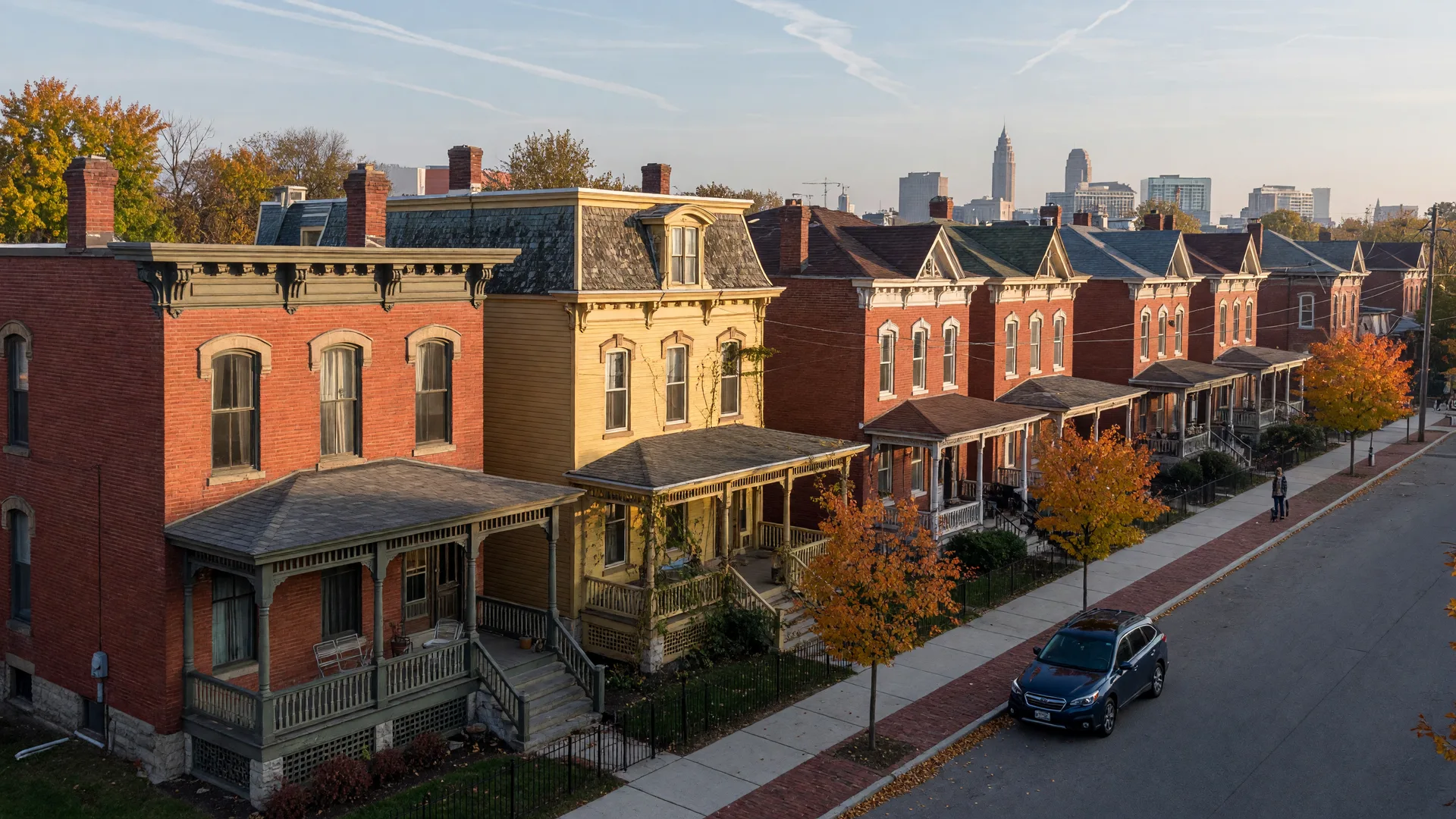
In Cleveland's Ohio City Historic District, any material change to a home's exterior, from replacement windows and new siding to roofing, porch work, fences, and full demolition, requires a Certificate of Appropriateness (COA) from the Cleveland Landmarks Commission before the work can begin. In Clifton Park, the historic garden suburb in Lakewood listed on the National Register of Historic Places since 1974, the federal listing itself restricts nothing a private homeowner can do to their house. The difference is two separate layers of protection: local landmark district designation, which has real enforcement teeth, and National Register listing, which is honorary. Here is what each layer actually means for the home you are buying, selling, or renovating.
Greater Cleveland has 29 locally designated historic districts and more than 300 locally designated landmark buildings, homes, and sites, and each district carries its own rules. Ohio City is the best known of them, a neighborhood of mostly late-19th-century brick and frame homes directly across the Cuyahoga River from downtown, with its landmark district running roughly between Franklin Boulevard and Bridge Avenue and from West 25th Street over toward West 38th and West 44th. Clifton Park is its opposite in nearly every way that matters for renovation: a private enclave of roughly 200 to 250 single-family homes on the bluffs above the Rocky River in far northwest Lakewood, protected in name only. The practical difference shows up every time a homeowner plans new windows, siding, or a roof.
What Is a Certificate of Appropriateness and When Do You Need One in Ohio City?
The legal foundation is Chapter 161 of the Cleveland Codified Ordinances, the Landmarks Commission Ordinance. Section 161.05 says no owner may make any "environmental change" to a designated landmark or to property inside a landmark district without a COA, and Section 161.02 defines environmental change as any alteration, demolition, removal, or construction, with alteration meaning any material change in the external architectural features of a building. Interior work is out of scope; the rule is about what a passerby can see from the street.
In practice the COA rides along with the building permit. Building permit applications for work in a landmark district are automatically treated as COA applications, so you do not file a separate historic application in most cases, you apply for your permit and the landmarks review rides with it. Minor work can be approved administratively by Landmarks staff. Larger projects go to the Historic Ohio City Design Review Advisory Committee (DRAC), which meets the first and third Thursdays of the month and recommends a decision, and then to the full Landmarks Commission. Every project is judged against the Secretary of the Interior's Standards for Rehabilitation, the city's adopted design standards and guidelines, and the neighborhood's own design guidelines.
| Layer | Ohio City Historic District | Clifton Park, Lakewood |
|---|---|---|
| Historic designation | Cleveland local landmark district (designated 1982, includes the former Franklin Circle Historic District) plus National Register listing | National Register listing only: Clifton Park Lakefront District (1974) and Clifton Park South (2021) |
| Who enforces it | Cleveland Landmarks Commission and staff, with the Historic Ohio City DRAC recommending decisions | No historic enforcement body; Lakewood's Building Department and Architectural Board of Review apply citywide standards |
| What requires review | Any exterior environmental change: windows, siding, roofing, porches, fences, additions, demolition | Exterior changes visible from the public right-of-way that are not consistent with Lakewood's Residential Architectural Design Standards |
| Design standard | Secretary of the Interior's Standards for Rehabilitation plus city and neighborhood guidelines | Lakewood Residential Architectural Design Standards (Chapter 1325, adopted May 2024) |
| Consequence of skipping review | Penalties under Section 161.99, minimum maintenance duties under 161.09, and a six-month negotiation hold after a disapproval | Building permit is withheld until the Architectural Board of Review approves the Design Review application |
Which Exterior Changes Require Approval in a Cleveland Historic District?
Because the definition of environmental change is so broad, nearly everything on the outside of the house is on the list. Window replacement, siding, roofing, porch and railing work, fences and yard walls, additions, and demolition all trigger COA review in a local landmark district. The level of review scales with the project: staff can approve minor work administratively, while substantial work goes before the DRAC and the full Commission. Demolition gets the heaviest review of all, and a disapproval can trigger a six-month waiting period during which the Commission negotiates with the owner.
| Exterior change | COA needed in Ohio City? | What the review looks for |
|---|---|---|
| Replacement windows | Yes | Repair is preferred under the Standards; replacement must match the original design, material, and profile |
| Vinyl or aluminum siding | Yes | Generally not consistent with the Standards, which favor keeping the original siding material; checked against the city's Residential Siding and Exterior Elements Guide |
| Roof replacement | Yes | Replacement must respect the original material and profile where feasible |
| Porch repair or rebuild | Yes | Preserve the porch's original columns, railings, and detailing |
| Fence or yard wall | Yes | Placement, height, and materials reviewed against the neighborhood guidelines |
| Addition | Yes | Must not remove or obscure a character-defining exterior feature; siting and massing matter |
| Demolition | Yes | The heaviest review; a disapproval can trigger a six-month waiting period while the Commission negotiates |
| Interior remodeling | No | The COA covers exterior architectural features only |
| Repainting an already painted surface | Confirm with staff | Paint color alone is not clearly a COA trigger in Cleveland; in Lakewood, painting previously unaltered masonry does require ABR review |
| Sandblasting or chemical cleaning of masonry | Not permitted | Treatments that damage historic materials conflict with the Standards |
Can I Put Vinyl Siding on a Historic Home in Ohio City?
In almost every case, no. Three of the ten Secretary's Standards do most of the work in Ohio City reviews. Standard 2 says the historic character of a property must be retained and the removal of distinctive materials avoided. Standard 5 says distinctive features, finishes, and craftsmanship must be preserved. Standard 6, the one that decides most daily projects, says deteriorated historic features should be repaired rather than replaced, and that where replacement is unavoidable, the new feature must match the old in design, color, texture, and, where possible, materials.
For a homeowner, the standard plays out like this: the review favors re-glazing and weatherstripping an original wood sash over dropping in a new window, and it favors repairing or replacing siding in kind over covering the original facade. Vinyl siding generally fails because it covers the historic siding, changes the building's texture and profile, and is not a repair at all. The same logic covers roofing. An asphalt shingle roof on a 19th-century house can be replaced when it wears out, but the review expects the replacement to respect the original material and profile, and a house with slate usually keeps slate or a slate-look equivalent.
Does National Register Listing Restrict What You Can Do to Your Home?
For a private homeowner, no. The National Register of Historic Places is an honorary list. It does not trigger design review, permit requirements, or any restriction on alterations or demolition for a private owner. Restrictions come only from local ordinance or from federal involvement, such as when federal money or a federal rehabilitation tax credit is in play on an income-producing property.
That is exactly the situation in Clifton Park. The neighborhood sits on the register in two pieces: the Clifton Park Lakefront District, listed in 1974, and Clifton Park South, added in 2021. The community itself was laid out beginning in the 1890s by the Clifton Park Association, with a residential plan by landscape architect Ernest W. Bowditch. The original deed restrictions required single-family use, set-back lines, and minimum construction investment, but by the trustees' own account there were no design or architectural restrictions in them. What that means in 2026: National Register recognition does not stop a Clifton Park owner from changing windows, siding, or paint, and no homeowners group holds architectural review power over a private owner's exterior.
What About Lakewood's Architectural Board of Review?
Being outside a local landmark district does not mean anything goes. Lakewood runs a citywide design review for residential exteriors under its Residential Architectural Design Standards, adopted May 2024 and written into Chapter 1325 of the city code. Under those standards, a Design Review application to the Architectural Board of Review (ABR) is required before: demolishing a residential building; building a new house or an addition visible from the public right-of-way; building or altering an accessory dwelling unit; and making changes to an existing home that are visible from the right-of-way and not consistent with the standards, as the Building Department determines. Painting previously unaltered masonry is a specific trigger under Chapter 1325.
The ABR meets the second Thursday of each month at 5:30 p.m. at Lakewood City Hall, 12650 Detroit Avenue, and its approval must be in hand before the building permit is issued. Lakewood also has a separate historic preservation ordinance, Chapter 1134, that lets the city designate Historic Preservation Districts and Historic Properties; a locally designated property needs a Certificate of Appropriateness from the ABR for exterior changes, with the Heritage Advisory Board advising. Clifton Park is not under a Chapter 1134 designation, so its homeowners work with the citywide standards and the ABR rather than a historic COA.
What Cleveland Buyers and Sellers Should Know About Historic District Rules
In our experience helping buyers and sellers across Greater Cleveland, the biggest surprise is how early in a transaction the historic rules bite. A buyer falls for a four-square in Ohio City with tired original windows, prices out replacements, and only finds out mid-negotiation that the window they chose needs review and may not pass. Here is how we plan for it: before a buyer writes an offer, we check whether the address sits inside a local landmark district boundary, and we ask what exterior work the buyer actually plans, because the first year of ownership is when window, siding, and roofing questions surface. On the listing side, we document completed exterior approvals and recent exterior work and share them up front, because a buyer who sees a clean paper trail stops adding contingencies.
Two planning notes for anyone renovating. First, order of operations: the COA review happens before the building permit, so a schedule that expects to start demo two weeks after closing will slip if the review runs long. Administrative approvals are fast, but a full Commission review on a substantial project moves at the pace of the meeting calendar. Second, budget: historically appropriate materials cost more than the vinyl-and-vinyl-window alternative, so the review is not just a paperwork step, it shapes the actual line items in a renovation bid. Work with a contractor who has built inside a landmark district before, and confirm the current application requirements with Landmarks staff at the start, not after you have already chosen your windows.
Buyer and Seller Takeaways
- Buyers: check whether the address sits inside a local landmark district boundary before you write an offer, and list any planned exterior work so you know what review it will need.
- Buyers: budget for historically appropriate materials. Repair and match-in-kind work typically passes review; replacement materials like vinyl siding often do not.
- Sellers: share completed or pending exterior approvals and a record of recent exterior work up front to shorten a buyer's inspection period.
- Clifton Park buyers: the National Register listing restricts nothing you can do privately, but Lakewood's Architectural Board of Review still applies to exterior changes visible from the street.
- Everyone: this is general education, not legal advice. For a specific house, confirm the rules with the Cleveland Landmarks Commission, Lakewood's Building Department, or your attorney before you sign a contract on exterior work.
If you are weighing a home in the Cleveland market, our Cleveland market coverage maps the communities and price points, and our Lakewood and Rocky River commute fact-check covers the west-side suburbs where historic districts like Clifton Park sit within easy reach of downtown. For the far east side of the market, our Geauga County well water guide covers the other kind of systems question that catches buyers off guard, and our guide to moving to Northeast Ohio walks through the region's housing, costs, and commutes.
Frequently Asked Questions
Do I need approval to replace windows in Ohio City?
Yes. Replacement windows are an exterior alteration on property inside a local landmark district, so a Certificate of Appropriateness review rides with the building permit. The review prefers repair, and if replacement is unavoidable, the new window must match the original design, material, and profile.
Can I put vinyl siding on a historic home in Ohio City?
Usually not. Vinyl siding covers the historic siding and changes the building's texture and profile, which is not consistent with the Secretary of the Interior's Standards for Rehabilitation that guide review. The city's Residential Siding and Exterior Elements Guide is the specific reference Landmarks staff apply.
Does Clifton Park's National Register listing restrict what I can do to my house?
No. National Register listing is honorary and does not limit private alterations or demolition. Lakewood's citywide Residential Architectural Design Standards still apply to exterior changes visible from the public right-of-way, and the Architectural Board of Review must approve a Design Review application before the building permit is issued.
Do I need approval to paint my house in Ohio City?
Paint color alone is not clearly a Certificate of Appropriateness trigger in Cleveland, and the review is not aimed at routine repainting of an already painted surface. In Lakewood, painting previously unaltered masonry does require review by the Architectural Board of Review. Confirm the current answer with staff for your specific address.
What happens if I do exterior work without approval in Ohio City?
The Landmarks Commission ordinance includes penalties for violations under Section 161.99 and a minimum maintenance requirement under Section 161.09. After a disapproval, the Commission can impose a six-month waiting period during which it negotiates with the owner, and unapproved work can stall at the permit stage.
How long does the review take in Ohio City?
Minor work can be approved administratively by Landmarks staff. Larger projects go to the Historic Ohio City Design Review Advisory Committee, which meets the first and third Thursdays of the month, and then to the full Landmarks Commission, so the meeting calendar drives the timeline. Plan for it before you schedule a contractor.
Sources
- Cleveland Codified Ordinances, Chapter 161 (Landmarks Commission) (COA requirement, definitions, maintenance, penalties)
- Cleveland Landmarks Commission, Landmarks Design Review (COA process, review levels, permit linkage)
- Historic Ohio City Design Review Advisory Committee (DRAC) (meeting schedule and advisory role)
- Cleveland Landmarks Commission, Design Standards and Guidelines (adopted standards, siding and exterior elements guide)
- City of Cleveland, Designated Landmarks (29 local historic districts, 300+ landmark properties)
- Ohio City Inc., Historic District (district boundaries and guidance)
- National Park Service, Secretary of the Interior's Standards for Rehabilitation (Standards 2, 5, 6 on retaining, repairing, and matching historic materials)
- City of Lakewood, Residential Architectural Design Standards, May 2024 (Chapter 1325 design review triggers and standards)
- City of Lakewood, Architectural Board of Review (meeting schedule, Design Review application)
- Lakewood Codified Ordinances, Chapter 1134 (Historic Preservation Districts and Historic Properties)
- Lakewood Historical Society, Historic Preservation Ordinance FAQ (what local designation does and does not do)
- Clifton Park Trustees, History: The Beginning (1890s layout, Bowditch plan, original deed restrictions)
- Encyclopedia of Cleveland History, Clifton Park (garden suburb history and governance)
- cleveland.com, Clifton Park Receives National Register Designation, June 2021 (Clifton Park South listing)
- Ordinance, district, and review details verified October 6, 2026 against the sources above.
Share This Post
Suggested social caption
"New windows in Ohio City need a Certificate of Appropriateness from the Cleveland Landmarks Commission. In Clifton Park, the National Register listing restricts nothing a private owner can do. Here is what each layer of historic protection actually means for your house, from Glasshouse Realty."
Published October 6, 2026 · Updated October 6, 2026 · Information verified on October 6, 2026 against the sources listed above. District boundaries, ordinance provisions, and review schedules can change; confirm current requirements with the Cleveland Landmarks Commission, Lakewood's Building Department, or your attorney before you start exterior work.
Buying or selling a historic home in Greater Cleveland?
Get a no-pressure, data-backed read on the Cleveland market, the historic district questions to ask before you write an offer, and the communities that fit your life. We know Ohio City, Clifton Park, Lakewood, and every corner of the region.
Talk to an AgentBuying or selling in Greater Cleveland, Ohio?
Whether you are buying, selling, or just weighing the move, a Glasshouse agent can show you the real Cleveland market, the historic district rules that matter for the home you are considering, and the communities that fit your life.
No pressure, no guesswork. Just honest, local answers from a team growing across Ohio.
Schedule a Consultation