
October 21, 2026 · Tax Guide
County Line Road Tax Check: Kettering's 2.25% Income Tax vs. Beavercreek's 0%, and the $300,000 Home Math on Each Side of the Montgomery-Greene Line
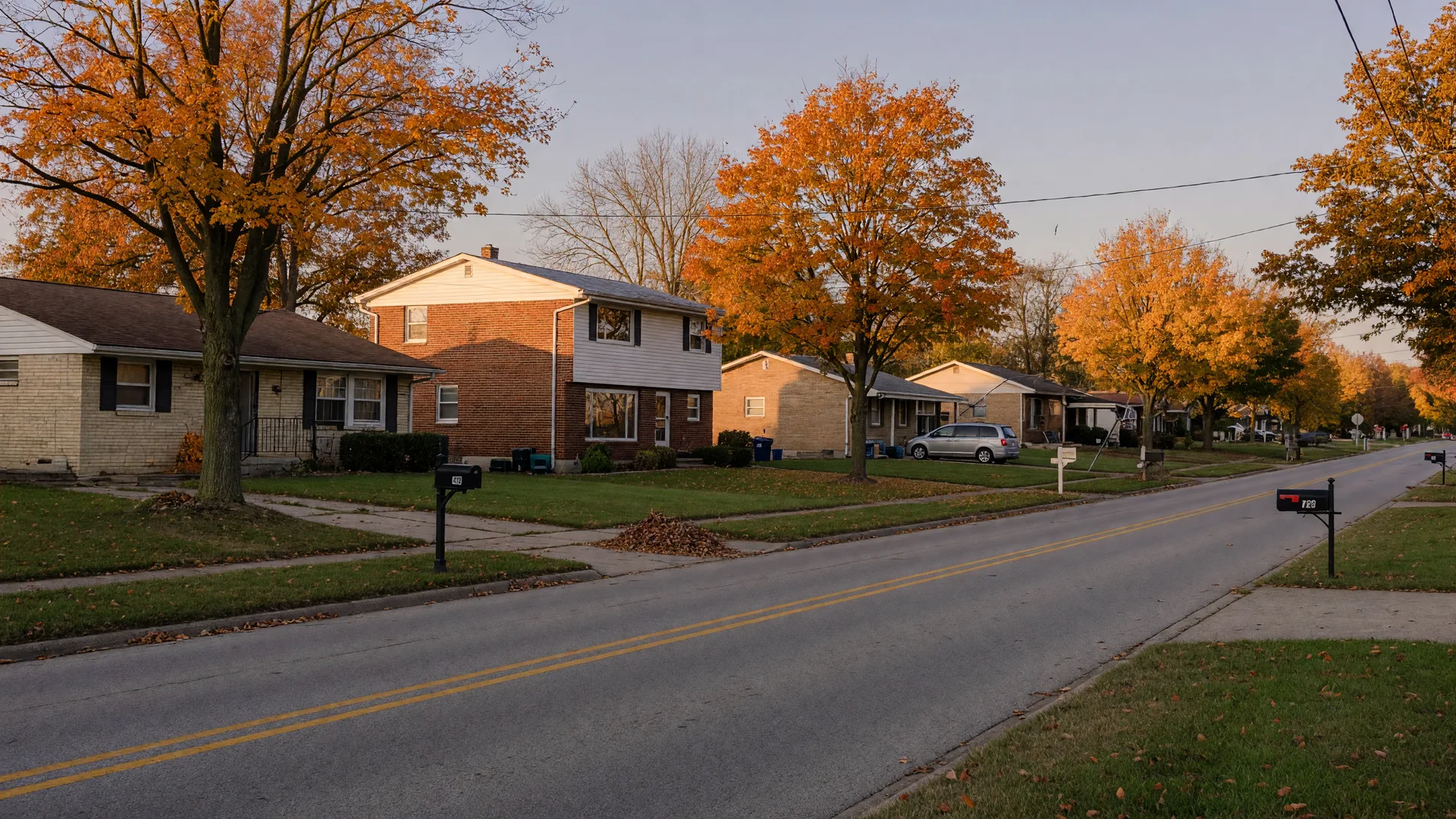
County Line Road is the actual border between Kettering, Ohio in Montgomery County and Beavercreek, Ohio in Greene County, so two similar homes across the street can carry very different local tax bills. Kettering charges a 2.25 percent municipal income tax on earned income, while Beavercreek charges 0 percent today, one of only three Ohio cities without one. On the property side the two are close, within a few effective mills on each side of the line. The income tax line is what separates them: on $100,000 of household earned income it is $2,250 a year in Kettering and $0 in Beavercreek, while both counties' 2026 reappraisals point to only small 2027 bill increases. Here is the verified math, with the county and city sources, as of October 21, 2026.
Where exactly is the Montgomery-Greene county line between Kettering and Beavercreek?
The line is a road, and its name gives it away. County Line Road follows the Montgomery-Greene county line for its run between the two cities, so the street itself is the boundary: a home with a Kettering address sits on the Montgomery County side, and the home across the same street carries a Beavercreek address on the Greene County side. Redfin and Walk Score records illustrate it directly, with 2770 County Line Road (45430) listed in Beavercreek and Greene County, and 2901 County Line Road in Kettering. The two cities have repeatedly cooperated on the road itself, including a roughly $4 million widening from Dorothy Lane to Vale Drive completed in 2022, reported by the Dayton Daily News. Along this corridor the county line usually also changes the school district, since Kettering City Schools serve the Montgomery side and Beavercreek City Schools serve most of the Greene side, and the school district is the largest single driver of a property's millage.
Table: The county line at a glance. Income tax rates from the City of Kettering and City of Beavercreek tax pages; effective millage from the City of Beavercreek's own 2022 residential property tax report (79.91 Beavercreek vs. 80.23 Kettering); effective rates on market value are third-party estimates from Ownwell; 2026 medians are Redfin figures from February 2026. All accessed October 21, 2026.
| Metric | Kettering | Beavercreek |
|---|---|---|
| County | Montgomery | Greene |
| Municipal income tax | 2.25% | 0% today (1% on Nov 3, 2026 ballot) |
| Effective millage (city report, 2022) | 80.23 | 79.91 |
| Effective rate on market value | ~2.19% (Ownwell); 2.05% (county guide, 45429) | ~2.29% (Ownwell); ~1.97% (Township) |
| 2026 median sale price | ~$246,750 | ~$299,999 |
How does Kettering's 2.25% income tax compare with Beavercreek's 0%?
The income tax is a tax on earned income, not on the house, so it hits every year and it is the biggest single dollar difference across this line. Kettering's official taxpayer page lists a 2.25 percent municipal income tax for both residents and nonresidents working in the city; Kettering taxes its residents on income earned anywhere and gives a credit for taxes paid to other municipalities, capped at Kettering's 2.25 percent rate. Beavercreek currently levies no municipal income tax at all, which the city states plainly on its taxation page, putting it in a group of only three Ohio cities without one, along with Bellbrook and Cortland. On $100,000 of household earned income, that is $2,250 a year in Kettering and $0 in Beavercreek, a $22,500 difference over ten years.
Table: Local income tax on $100,000 of earned income by side of the line. Rates are from the City of Kettering and City of Beavercreek tax pages and tax returns; credits offset tax paid to a work city up to the home city's rate. Illustration for general education only, not tax advice, accessed October 21, 2026.
| Jurisdiction | Municipal Income Tax Rate | Tax on $100K | Credit for Tax Paid to Work City |
|---|---|---|---|
| Kettering | 2.25% | $2,250 | 100% up to 2.25% (residents) |
| Beavercreek | 0% today | $0 | n/a |
What is the property tax math on a $300,000 home on each side?
Property tax is where the two sides are close. The City of Beavercreek's own 2022 residential property tax report puts the effective millage at 79.91 in Beavercreek versus 80.23 in Kettering, nearly identical, which the report translates to roughly $2,536 versus $2,540 in annual tax on a median-priced home in each city. Ohio assesses property at 35 percent of market value, and state reduction factors bring nominal millage down to an effective rate; third-party estimates from Ownwell put the effective rate on market value near 2.19 percent in Kettering and 2.29 percent in Beavercreek, while the Montgomery County Auditor's property-tax demographics guide lists the Kettering City School District slice of ZIP 45429 at about 2.05 percent. The property bill on a $300,000 home therefore lands a few hundred dollars apart, with Beavercreek slightly higher, before the income tax is added. On the same $300,000 home with $100,000 of household income, Kettering's total local bill comes out roughly $1,950 a year higher, because its $2,250 income tax more than offsets the small property-tax difference.
Table: Annual local tax estimate on a $300,000 home with $100,000 of household earned income. Property tax uses Ownwell median effective rates on market value; income tax uses official city rates. Estimates only, not a tax quote; the county auditor computes the exact figure for a specific parcel, accessed October 21, 2026.
| Line item | Kettering (Montgomery Co.) | Beavercreek (Greene Co.) |
|---|---|---|
| Income tax on $100,000 | $2,250 | $0 |
| Property tax on $300,000 | ~$6,570 | ~$6,870 |
| Total local tax | ~$8,820 | ~$6,870 |
| Difference per year | ~$1,950 more | ~$1,950 less |
What happens if you live on one side of County Line Road and work on the other?
The border produces two very common scenarios, and both end with a payment to Kettering. If you live in Kettering and work in Beavercreek, Kettering taxes your income wherever you earn it, and since Beavercreek levies no income tax there is nothing to credit, so you owe Kettering the full 2.25 percent. If you live in Beavercreek and work in Kettering, your employer withholds Kettering's 2.25 percent as nonresident tax on the wages earned in Kettering, and Beavercreek charges you nothing as a resident, so your net municipal income tax is still 2.25 percent of your income. The person who pays nothing is the Beavercreek resident who also works in Beavercreek. Employer withholding follows the work city in Ohio, so your job location, not your street address, decides the withholding line.
Table: Two commute scenarios across the county line, using the 2026 rates and a $100,000 income. Withholding follows the work city; the credit rules come from the Kettering individual income tax return and the City of Beavercreek tax pages, accessed October 21, 2026.
| Line item | Kettering resident, works in Beavercreek | Beavercreek resident, works in Kettering |
|---|---|---|
| Residence-side tax | Kettering 2.25% = $2,250 | Beavercreek 0% = $0 |
| Work-city tax withheld | $0 (Beavercreek levies none) | Kettering 2.25% = $2,250 |
| Credit | None (nothing to credit) | None (residence tax is $0) |
| Net municipal income tax | $2,250 | $2,250 |
What do the 2026 Montgomery and Greene county reappraisals mean for 2027 bills?
Both counties completed full reappraisals for tax year 2026, the year that sets 2027 bills, and both published the same headline: values rose sharply, but bills will not rise proportionally. Montgomery County's 2026 reappraisal raised countywide values from about $39 billion to nearly $46 billion, a 19.5 percent gain with residential values up about 19 percent, an average increase of roughly $35,678 per home, and about 92 percent of homeowners saw some increase. Kettering had the second-largest dollar gain in the county, up about $703 million, behind only Dayton. County Auditor Karl Keith has emphasized that Ohio's House Bill 920 reduction factors cap revenue from most existing voted levies, so the auditor projected an average 2027 tax increase of only about 1.5 to 2 percent for most homeowners; in October 2026 the county also approved a $12.5 million property tax reduction for 2027 required under House Bill 335, expected to save residential owners about $20 per $100,000 of home value, with impacts listed for Kettering City and Kettering City School District. Tentative value notices went out in July 2026, and owners could challenge values through informal review at MCReval.org or the hotline at 937-224-8927.
On the Greene County side, the Greene County Auditor's 2026 reappraisal raised countywide values about $4.759 billion, with residential properties up 17.77 percent. Beavercreek residential values rose an average of just over 17 percent, the third-largest gain among county municipalities behind Xenia at about 26 percent, Bellbrook at 21 percent, and Fairborn at 19 percent. Tentative notices mailed in June 2026 with informal reviews held July 13 through 24, 2026. Because most of Beavercreek's property tax revenue comes from voted levies whose rates adjust after a reappraisal, the city's finance director projected only a roughly 1 to 2 percent revenue increase for 2027 despite the higher values. The practical takeaway: a higher reappraisal value is not automatically a higher tax bill, but it is worth reviewing the tentative value on either side of the line before it becomes final.
What is on the Beavercreek ballot on November 3, 2026?
Beavercreek voters decide a charter proposal on November 3, 2026 that would impose a 1.0 percent municipal income tax effective July 1, 2027, paired with a 50 percent cut in the city's property tax. The proposed income tax code, published by the city, includes a 100 percent credit, up to Beavercreek's 1 percent rate, for income taxes Beavercreek residents already pay to other municipalities, so a Beavercreek resident working in Kettering would still owe nothing extra to Beavercreek even under the proposal. If approved, the border math changes starting in mid-2027: part of the local burden in the city of Beavercreek shifts from property to income, while Kettering's 2.25 percent rate and the county-line commute scenarios stay as they are. As of this writing the vote has not happened, so treat the current 0 percent rate as the operative number and watch the result after November 3.
How should a buyer compare the tax line before making an offer?
In our experience running the annual tax math for buyers who cross this line, the income tax is the number people forget, because it never appears on a listing, an appraisal, or a closing disclosure; the property tax shows up everywhere, and the income tax shows up only on the first W-2 after you move. So we model both, and we model them on the household's actual income and the exact work city, because the two sides of County Line Road can flip the answer for a two-earner household. Here is the checklist we use before a buyer compares two addresses.
- Pull the exact taxing district for each parcel from the county auditor (Montgomery County for the Kettering side, Greene County for the Beavercreek side), not a city-wide average, because school district and special districts set the real millage.
- Ask for the current effective property tax rate, since Ohio's reduction factors make it lower than the nominal millage printed on levy ballots.
- Model the municipal income tax on your actual household income and each earner's work city, using the 2.25 percent Kettering rate and the 0 percent Beavercreek rate, and check the credit rules if either earner works in Kettering.
- Confirm both 2026 reappraisal values on the tentative notices, and file an informal review by the county deadline if a value looks out of line with recent sales.
- Track the November 3, 2026 Beavercreek ballot measure, because a 1 percent income tax with a 50 percent property tax cut would change the city's mix starting July 1, 2027.
- Verify the school district assignment parcel by parcel; the county line and the school line do not always match, and the district drives the biggest share of the bill.
This is general educational information about local taxes, not tax or legal advice. Your exact bill depends on the parcel, the year, and your income, so work with a tax professional, the Montgomery County Auditor, and the Greene County Auditor for the precise figure on a specific address. For the wider picture, see our guide to the 2026 Montgomery County reappraisal, our 0% municipal income tax havens comparison, the how property taxes work in the Dayton area explainer, and the Kettering and Beavercreek market updates, plus the Greater Dayton region page for the full market view.
Frequently Asked Questions
Does Kettering or Beavercreek have higher property taxes?
They are close. The City of Beavercreek's 2022 residential property tax report lists effective millage of 79.91 in Beavercreek versus 80.23 in Kettering, roughly $2,536 versus $2,540 in annual tax on a median-priced home in each city. Third-party effective-rate estimates put Beavercreek slightly higher on market value, near 2.29 percent versus 2.19 percent, but the bigger difference across the line is the income tax, not the property tax.
How much does the Kettering income tax cost me each year?
Kettering's municipal income tax is 2.25 percent on earned income. On $100,000 of household income that is $2,250 a year. Kettering taxes residents on income earned anywhere and gives a credit for taxes paid to other municipalities, capped at its 2.25 percent rate, so the tax is at its full value when you work in a city that levies no income tax, such as Beavercreek.
If I live in Kettering and work in Beavercreek, what income tax do I pay?
You pay Kettering's 2.25 percent resident income tax on the income you earn, even though the job is in Beavercreek. Because Beavercreek levies no income tax, there is nothing to credit, so you owe Kettering the full 2.25 percent, $2,250 on $100,000 of income.
If I live in Beavercreek and work in Kettering, what do I pay?
Your employer withholds Kettering's 2.25 percent as nonresident tax on the wages earned in Kettering, and Beavercreek charges you nothing as a resident. Your net municipal income tax is still 2.25 percent of that income, $2,250 on $100,000, the same figure as the Kettering resident working in Beavercreek.
Will the November 3, 2026 Beavercreek income tax vote change the tax line?
If approved, Beavercreek would impose a 1.0 percent municipal income tax effective July 1, 2027, paired with a 50 percent cut in the city's property tax. The proposed code includes a 100 percent credit, up to 1 percent, for taxes residents already pay to other municipalities, so a Beavercreek resident working in Kettering would still owe nothing extra to Beavercreek. As of October 21, 2026 the vote has not happened, and the current rate remains 0 percent.
What changed in the 2026 reappraisals for homeowners on each side?
Both counties reappraised for 2027 bills. Montgomery County values rose 19.5 percent countywide, with Kettering up about $703 million, the second-largest dollar gain in the county. Greene County values rose about $4.759 billion, with Beavercreek residential values up just over 17 percent. Ohio's House Bill 920 caps revenue from most existing levies, so both counties project average 2027 increases of only about 1.5 to 2 percent, and Montgomery County approved a $12.5 million reduction for 2027.
Sources
- City of Kettering: Individual Taxpayer Information (2.25% income tax rate)
- City of Kettering: 2025 Individual Income Tax Return (credit capped at 2.25%, residents)
- City of Beavercreek: Taxation (no municipal income tax)
- City of Beavercreek: Proposed 1% Income Tax Code 2026 (November 3 ballot, 100% credit)
- Dayton Daily News: Beavercreek income tax ballot issue (1% tax for property tax cut)
- City of Beavercreek: 2022 Residential Property Taxes (effective millage 79.91 vs. Kettering 80.23)
- Ownwell: Beavercreek effective property tax rate (~2.29%)
- Ownwell: Kettering effective property tax rate (~2.19%)
- Montgomery County Auditor: Property Demographics & Tax Rates (Kettering CSD 2.05% effective, ZIP 45429)
- Montgomery County: 2026 Property Reappraisal
- Montgomery County Auditor: Rates of Taxation for 2025 (Payable 2026)
- Register Herald: Montgomery County reappraisal reflects strength (values up 19.5%, Kettering +$703M)
- Dayton Daily News: Montgomery County approves $12.5M property tax reduction for 2027
- Greene County Auditor: 2026 Property Revaluation
- Greene County: Property Revaluation FAQ
- City of Beavercreek: Understanding Your Property Reappraisal (July 16, 2026)
- Dayton Daily News: Greene County property values jump (residential +17.77%)
- Dayton Daily News: County Line Road widening between Kettering and Beavercreek
- Redfin: Kettering housing market data (median ~$246,750, Feb 2026)
- Redfin: Beavercreek housing market data (median ~$299,999, Feb 2026)
- Zillow: Kettering home values
- Zillow: Beavercreek home values
- Redfin: 2770 County Line Rd, Beavercreek (Greene County) address example
Social caption: County Line Road is the real Montgomery-Greene border between Kettering and Beavercreek, and it is a tax line: 2.25% income tax on the Kettering side, 0% in Beavercreek today, with property millage within a few mills of each other. On a $300K home with $100K income, that is about $1,950 a year. Full tables, the commute scenarios, both 2026 reappraisals, and the Nov 3 Beavercreek ballot. Link in bio. #OhioRealEstate #KetteringOH #BeavercreekOH #GreeneCounty #MontgomeryCounty #GlasshouseRealty
Information verified October 21, 2026 · Published October 21, 2026 · Updated October 21, 2026
Comparing a home on either side of County Line Road?
Tell us the two addresses and your household income, and we will pull the exact taxing districts, effective millage, and income tax lines for the Kettering and Beavercreek sides before you schedule a showing. No pressure, just the numbers.
Talk to an AgentWeighing the Kettering and Beavercreek sides of the line?
Whether you are buying in Montgomery County or Greene County, a Glasshouse agent can walk you through the property tax, income tax, and price picture in one conversation, including the two 2026 reappraisals and the November ballot measure.
We help buyers compare Kettering and Beavercreek addresses across the county line every week, including the income tax and millage that set the true monthly cost of a home.
Schedule a Consultation